03 September 2010

Some Thoughts on Colonialism

I was born in a small town in the central North Island of New Zealand, child of 3rd and 4th generation settlers. About half my neighbourhood were Māori. New Zealand is a relatively young country, having been formally recognised as such in 1840 with the signing of a treaty between Queen Victoria of the United Kingdom, and several influential Māori chiefs (this is symbolised on our coat of arms, left). The Māori themselves are one arm of a vast colonising movement that settled most of the habitable islands of the Pacific Ocean, arriving in New Zealand around 1000 years ago. People in the UK like to joke about the Antipodes being populated by criminals - this is not in particularly good taste. We don't laugh about concentration camps or slavery, and the British transportation of convicts to Australia was hardly any more humane. But as any New Zealander will be quick to tell you our country was not populated convicts. However our country was founded by white-collar criminals.

At the heart of the original fraud were the two versions of the Treaty of Waitangi. In the Māori language version the locals ceded kawanatanga 'governorship' to the British, but crucially maintained tino rangatiratanga 'full chieftainship' over their people, lands and possessions. In return the British would establish a government to help protect everyone from the rapacious and violent foreign visitors who had begun arriving in the late 1700's, and to act as an intermediary in land sales. Māori gained all the rights of British subjects. The chiefs had been prompted, partly by the arrival of a French Catholic mission and a significant American presence in the form of whalers, to chose the English as the lesser of three evils. In the English version of the Treaty the chiefs ceded sovereignty to the Queen. This opened the door for exploitation because although they gained rights and protections as British subjects, the chief's right to rule their own people was effectively removed. And in any case the British were loath to treat the Māori as British subjects on a par with themselves, because they had brown skin and a non-European culture. While some attempt was made to take copies of the Treaty around the country, not all of the chiefs would sign, and not everyone had an opportunity.

The New Zealand Company, crucial to the early development of New Zealand as a colony, was the brainchild of the devious and unscrupulous Edwin Gibbon Wakefield, a convicted felon himself (having been found guilty of abduction). This company sold land to settlers before providing one-way transport out. The land they sold was not legally theirs, and indeed they sold more land than the whole surface area of the islands. Initially they could only buy land which had been purchased on their behalf by the Queen - through her representative in the form of a Governor. The first Governor, William Hobson, embezzled most of the money, then died. His temporary replacement Willoughby Shortland misappropriated the rest, leaving the fledgling country more or less bankrupt. This meant that very little land was being purchased while thousands of settlers were arriving each year. The settlers began to take land against the wishes of the Māori, which caused tension and bloodshed.

For a brief period the tragic figure of Robert Fitzroy (ex Captain of the famous HMS Beagle) became Governor and tried to be fair to both locals and settlers. But he was unpopular with the settlers because of this. The lack of income from selling land also prevented any kind of public works program. In addition New Zealand Company executives owned the local press and published stories which suited their purpose both in New Zealand and in London. Fitzroy was soon deposed and the land grab was prosecuted with increasing vigour under his replacement George Grey. By around 1860 the Māori had drawn a line in the sand and warned the settlers that no more land would be sold, or allowed to be taken. But thousands of settlers continued arrive, many of whom had already purchased land in the UK.

An excuse was invented and war was prosecuted during which some 4 million acres were seized, and many of the defenders killed, or imprisoned. Those fighting for their land were deemed by Act of Parliament to be rebels who could be detained indefinitely without trial. They were often shipped far to the south where the conditions were very poor and cold - our very own Guantánamo Bay. When I was young we called this period of conflict "the Land Wars" but the current PC term is "the New Zealand Wars". However the reason for, and the object of, the wars was taking land from Māori. Again it is possible to draw parallels with the war in Iraq and American and British concerns over the flow of oil. With the destruction of their civilisation and the introduction of European diseases, the Māori population plummeted and it was thought that they would quietly die out. Fortunately they did not.

During this period a number of great Māori leaders emerged, but one hero stands out for me. Te Whiti o Rongomai established a village called Parihaka in Taranaki. Here he preached the bible in the manner of an old testament prophet - for despite the capriciousness of the British, many Māori enthusiastically embraced Christianity. Indeed many of his followers saw Te Whiti as a prophet. After the war which saw all of the Māori land confiscated, he preached a course of non-violent resistance almost a century before Gandhi. They pulled up survey pegs and ploughed up roads to plant potatoes. When the army came for him they were met by women and children singing songs. Te Whiti was arrested and imprisoned for a year as a rebel in 1881. He never struck back. Probably because the news did not reach the rest of the world Te Whiti's struggle against injustice did not result in a loss of moral authority, as did Gandhi's.

But this is not what we learned as children. Our schooling painted the British as intrepid explorers and colonisers, heroic and noble; the Māori as backward, cowardly and savage. The truth is not quite diametrically opposed to this, but the portrayal is deeply wrong. The British were convinced of their racial and cultural superiority and determined to crush any resistance to their "civilising influence". They saw themselves as pre-ordained to rule over "the lower races", especially those who skin was not white. So while they were intrepid, their values were abhorrent by today's standards. The Māori were using stone age technology at the time of contact with Europeans. They could indeed be savage, but perhaps no more so than the British. Environmental pressures had forced them into a pattern of almost continuous small scale warfare as they competed for scarce resources. However they were quick to learn from Europeans, many converted to Christianity, and they initially prospered from their contact. But the settlers, lead by (and lead astray by) the New Zealand Company were greedy and would not settle for less than all of New Zealand. The Māori fought a successful guerrilla campaign against the invaders and usurpers. Although London had not sanctioned the war for land, and had asked the colonial government not to start it as they could ill afford to be involved in another foreign war, in the end they had to bail the colony out. Thousands of troops were sent, with the latest weaponry. The Māori were defeated by overwhelming force.

Although the first nation people dwindled they did not die out. Before my generation efforts were made to extinguish the Māori language - it was forbidden in schools for instance. By contrast I was able to formally study the language in secondary school. Now the Māori people and Māori language are having a renaissance. Children once again have Māori as a first language and receive primary and secondary education in Māori. Māori is an official language of New Zealand. In 1975 the Waitangi Tribunal was set up to begin to address grievances over land seizures and other breaches of the Treaty. This has helped to reaffirm the place of the Treaty in our legislature, though the two versions continue to cause distension. Reparation payments began to be made in the 1980's, and Māori have become more confident in pursuing claims through this court.

We are left with nation founded on deceit, which one side is only now owning up to. New Zealand is also home to other immigrants. Amongst the British (mostly English and Scots), were always a few Dutch and other Europeans. Former residents of Pacific Islands such as Samoa and Tonga are free to emigrate partly because New Zealand took over the British governance of them. More recently many East Asians have begun to arrive in substantial numbers. Multiculturalism is blooming even before we have come to terms with the history and consequences of colonialism. There is no question of returning New Zealand to the Māori, though no doubt they are still owed more in compensation than they have so far received. This is not a popular sentiment amongst many New Zealanders who cannot see why the grievances of a century ago continue to haunt us. Perhaps because we benefited so much from the cheating, and now have so much to lose. People of that view who visited England in 2010 might be surprised just how much feeling the invasion of 1066 can stir up amongst the English.

Until World War I (white) New Zealanders thought of themselves as British. The disastrous Gallipoli campaign began the process of separation, New Zealanders realised that the British didn't see us as British, but as 'colonials', and as such ideal as canon fodder. However it was the British themselves who effectively ended the connection between the two countries by joining the European Common Market in 1973. Until that time 80% of New Zealand exports were to Britain. After that the French blocked most of those exports, since New Zealand was in direct competition with France (and beat them on both quality and price), and today the figure is just 5%. These days the UK is looking to limit immigration from outside the European Union and this will certainly include former colonies. Although the Queen is still nominally the head of state, this seems less and less meaningful, and it seems only a matter of time before New Zealand becomes a republic - at which point the Treaty of Waitangi must be renegotiated which may prove interesting. Kiwis need to be clear that the British don't feel sentimental about New Zealand - it is a foreign country to them. During the 2007 rugby world cup I witnessed a pub full of English people cheering for France to beat New Zealand in the quarter-finals. They cheered for France!

For the children of settlers identity is a vexed issue. We are not tangata whenua or first nation people, and yet our home has cut us off and disowned us - so we are not people of the British Isles either. To make life more complicated many of us are adding a new religion to the mix. My friend Sally McAra has written about the issue of identity amongst New Zealand Buddhists in her book: Land of Beautiful Vision: Making a Buddhist Sacred Space in New Zealand (University of Hawai'i Press, 2007). Part of coming to terms with that identity must be reviewing the nature of our relationship with the Māori, who seem now to be stuck with us, and indeed very often share ancestors with us as well.

I suppose the stories of the many indigenous people who fell under the trampling boots of the Euro crowd as they swarmed across the globe gives us some insight into what a loss of culture and sense of identity looks like. People who do not know who they are, and do not belong anywhere seldom prosper. Having grown up amongst a dispossessed people I see that the Western Buddhist discourse on identity and belonging can be glib and superficial... we discount the notion that identity has any value. But it clearly does. Paraphrasing Sangharakshita I think we can say that before transcending one's identity, one must first have an identity.

27 August 2010

A Pāli Pun


In the Aggañña Sutta (DN 27.22) we find some interesting material on the Buddhist attitude to class prejudice. [1] We need to be clear that this not an objective historical record; it is a document which is meant to convince us of a particular view, or perhaps persuade against one. However, the fact that the Pāli texts recall the kinds of insults that Brahmins aimed at Buddhists suggests that there is some veracity in the texts, since they would probably not make up insults for themselves, nor preserve them. Some Brahmins saw the samaṇa as having taken on the status of śudra - the lowest of the four classes, though not the lowest level of Indian society, since one could be outcast. Note that 'Brahmin' is an Anglicisation of the Sanskrit brāhmaṇa usually adopted to avoid confusion with the texts of the same name. Here a former Brahmin called Vāseṭṭha who has converted to Buddhism recounts the kinds of insults he receives from Brahmins:

brāhmaṇova seṭṭho vaṇṇo, hīno añño vaṇṇo. Brāhmaṇova sukko vaṇṇo, kaṇho añño vaṇṇo. Brāhmaṇāva sujjhanti, no abrāhmaṇā. Brāhmaṇāva brahmuno puttā orasā mukhato jātā brahmajā brahmanimmitā brahmadāyādā. Te tumhe seṭṭhaṃ vaṇṇaṃ hitvā hīnamattha vaṇṇaṃ ajjhupagatā, yadidaṃ muṇḍake samaṇake ibbhe kaṇhe bandhupādāpacce.

Brahmins are the best class, the other class is defective (hīna). Brahmins are the pure [white] class, the other is impure [black]. Brahmins are the offspring of Brahmā's mouth, born from Brahmā, created by Brahmā, the kin of Brahmā. Having deserted the best class you have accepted the class that fails to measure up, with these baldy, petit-ascetic, menials, blacks, offspring of Brahmā’s feet! [DN 27.3, D iii.81]
Note the use of hīna in this context to describe the śudra class, and then hīnamattha which I've rendered 'fails to measure up' and does literally mean 'lacking a full measure'. The word for both 'pure' and 'white' is sukka; while the word for 'impure' and 'black' is kaṇha. The insults muṇḍaka 'bald' and samaṇaka 'ascetic' are in a diminutive form that is hard to capture in English - elsewhere they have been rendered "shaveling little ascetics". The last three terms (which can also be read as "menial, black offspring...") are often used of śudras. Indeed, the reference to "Brahmā's feet" is an allusion to Ṛgveda 10.90 The Puruṣa Sūkta. [2] However, I think the idea would have been a cliché (or, indeed, an insult) by the Buddha's day, so it doesn't necessarily suggest familiarity with the Ṛgveda, itself. These are insults that only a Brahmin could use. In looking for contemporary parallels I suggest that the language of white racist abuse is on a par with the passage above. However, projecting contemporary attitudes and understandings backward onto the texts is an uncertain enterprise, at best.

The Buddhist response in the Aggañña Sutta is a lengthy satire on Brahmanical cosmogony and views on the origins of the four classes that employs a series of puns. The funniest one is at DN 27.22 where the Buddha remarks that: ‘They don’t meditate’ (ajhāyaka) is the meaning of ‘brahmin student’ (ajjhāyaka).

However, I want now to focus on the first of the puns in this section. It is less obvious, less amusing, but offers some interesting reflections on the history of Budddhism.
Pāpake akusale dhamme bāhentīti kho, vāseṭṭha, ‘brāhmaṇā, brāhmaṇā’ tveva paṭhamaṃ akkharaṃ upanibbattaṃ. [D iii.93-4]
They ward off evil unwholesome things, Vāseṭṭha, [hence] they are ‘Brahmins’. This is the first pun produced.
The word akkharaṃ literally means 'constant', but also 'letter, sound'. Hence, it is used as the name of the Vedic science of phonology - the sounds of the letters being the constants of language and having a greater significance, even at an early date, than we assign to our letters. It is only a guess, but I think that it suggests 'pun' here - a play on words based on similar sounds. This makes more sense in view of the following discussion.

At first glance there is no pun in the passage quoted. However, brāhmaṇa is a Sanskrit form. In Pāli, consonant clusters like 'br' get resolved in various ways; e.g., the Sanskrit term śramaṇa becomes samaṇa in Pāli. This suggests that the form of our word should be bāhmaṇa and, indeed, Richard Gombrich notes that this form is found in some of Asoka's edicts. [3]

In his work An Outline of Meters in the Pāḷi Canon Ānandajoti notes that the conjunct br in brāhmaṇa regularly fails to “make position”; i.e., it fails to cause the preceding syllable to be metrically heavy. However, it does regularly make position medially. This suggests that brā was frequently treated as , at least for the purposes of meter.

If bāhmaṇa (possibly bāhmana) was the form, then we do have a pun with bāhenti, 'they ward off'. [4] This kind of sound alike etymology is called nirutti (S. nirukti) and relies on verbal roots having phonetic similarity. [6] The verb bāheti is said by PED to be a causative from bahati or a denominative perhaps related to Sanskrit bahis 'outward', which is also the opinion of Edgerton in BHSD. The root of which is obscure. Though John Brough thinks it unlikely [5], the root may be √vah 'carry' - there is a regular confusion of 'b' and 'v' in Indic languages [see note 4]. This idea that Brahmins have avoided or warded off evil is consistent with Brahmins claiming to be sukka - pure/white - but it also reflects the Buddhist notion that a Brahmin is a Brahmin because of their conduct, not because of their birth.

There are a number of texts in Pāli, Sanskrit and Gāndhārī which make use of this same pun - I'll highlight the key terms in italics, and add hyphens to compounds to help clarify the connection. At MN 39.24 (M i.280) we find:
Kathañca, bhikkhave, bhikkhu brāhmaṇo hoti? Bāhitāssa honti pāpakā akusalā dhammā...
And how is a bhikkhu a brāhmaṇa? They have warded off evil unskilful mental states…
Again, in the Dhammapada, verse 388:
bāhita-pāpo’ti brāhmaṇo, samacariyā samaṇo’ti vuccati
pabbājaya attano malaṃ, tasmā pabbajito’ti vuccati.

Brahmin means ‘evil put aside’, we call the calmly living ‘samaṇa’.
Putting aside his own impurity, he is called ‘gone forth’.
We have several versions of the Dhammapada. In the Gāndhārī language version of the Dharmapada [7] the parallel verse (DhpG 1.16) runs:

brahetva pavaṇi brammaṇo
samaïrya śramaṇo di vucadi
I refrain from attempting to translate, but these words are not so different from the Pāli (pavaṇi = pāpa). The 'r' in brahetva is probably an anomaly, since it is not found in either the Pāli or Sanskrit versions. John Brough (who edited the GDhp) notes that it may have been "artificially introduced to buttress the pseudo-etymology of brāhmaṇa, if this arose originally in a dialect which assimilated br- of the latter word"; but, overall, he is doubtful about deriving P. bāheti from √bah or √vah and links it to √brah or √barh. [8] However, if we derive the verb from the same root as brahmaṇa (actually √bṛh) then the verb means 'to strengthen' and the sentence means the opposite of the parallels - i.e., that the Brahmin is one who strengthens evil. So we can probably conclude that the Gandhāran composer understood that this was a pun, and because in their dialect brāhmaṇa is spelt brammaṃa, introduced an 'r' into the verb to preserve the pun. Though it is strange that they should do this and obscure the meaning. Gāndhārī baheti is also listed as equal to P. bāhetvā in Stefan Baums and Andrew Glass (preliminary) Gāndhārī Dictionary, so we know that the 'r' is not required in that dialect.

Another version of the Dhammapada survives in a Sanskrit text which is called Udānavarga (UV 11.15)
brāhmaṇo vāhitaiḥ pāpaiḥ
śramaṇaḥ śamitāśubhaḥ
Note that UV has vāhita like the variant Pāli, and consistent with Sanskrit usage of the verb. In turn, this leads us to two parallels from the Pāli Udāna:
Yo brāhmaṇo bāhita pāpadhammo (Ud 1.5)

He is a Brahmin who avoids evil states


Bāhitvā pāpake dhamme, ye caranti sadā satā;
Khīṇasaṃyojanā buddhā, te ve lokasmi brāhmaṇā 'ti (Ud 1.6)

Having avoided evil states, they always behave mindfully;
With fetters destroyed and awake, they are called brahmins in the world.
Max Müller (in his Dhp translation) notes another occurrence of our phrase in the (Buddhist Hybrid Sanskrit) Lalitavistara:
…trailokya-brāhmaṇaṃ bāhita-pāpakarmāṇaṃ bhikṣuṃ

...the three-worlds' Brahmin with evil deeds cast aside is a bhikṣu [LV 22.5]
Note that LV follows the Pāli in using bāhita. I've made no attempt at an exhaustive search; these are just the examples that come easily to hand. But still we have a number of passages which work together to show that at some point this pun on bāhenti/bāhmana must have been reasonably common, and have made sense - i.e., that the two words bāhetva/bāhita and bāhmaṇa shared the syllable bāh. We would have expected Pāli to preserve the pun, since bāhmana is the natural form of that word in Pāli. Since it did not, we have something of a mystery.

One possible conclusion is that the spelling was deliberately changed - and that this change affected not only the Pāli, but also the Buddhist Sanskrit usage. In turn, this suggests that LV emerged in a milieu that spoke a dialect closely allied to Pāli, though UV did not, since it uses the form vāhita. The change from bā > brā involves a Sanskritisation which suggests a Brahmin influence, since at the time Sanskrit was the sole preserve of the Brahmins, and yet it occurs precisely in the context of satires on Brahmanical beliefs. Madhav Deshpande has pointed to passages in the Lalitavistara Sūtra that indicate the "increasing prominence of Brahmanical elements within Buddhist traditions". [9] Perhaps Brahmin converts were able to live with the canonical criticisms of their former faith/culture and. in any case. could not erase them because it would be noticed; but they retained enough pride in their heritage to correct the spelling of their former social class across the whole canon?

Another possibility is that though the original dialect used bāhmaṇa, Pāli had brahmaṇa as a loan word directly from Sanskrit by the time the texts were translated into Pāli. The Gandhāran translator must have had (or heard) a text in the original dialect to see the pun, and make the unusual change they did. There is some linguistic evidence to suggest more than one wave of Indo-European speaking people moving into India, and that those who wrote the Vedas and built the Brahmanical culture may not have been directly connected to the earlier (or perhaps later) wave that moved much further east more quickly. This might allow for brāhmaṇa to be a new word to those in the East. But that is a complex argument, and this is now a long post. However, one important point to follow up would be to locate the Asoka use of bāhmaṇa geographically, and compare this to the most recent deliberations on the comparison of Pāli and the Asokan dialects.


~~| This is Rave no. 200 |~~

Notes
  1. There are some structural features which suggest that the text is not in its original form, especially the sudden transition between verse 9 and v.10. My guess is that a verse has which should introduce this part of the text has been lost. However, some have seen it as two separate texts. It is true that the narrative that stops at v.8 (v.9 is standalone and may not have originally been in this position) and is resumed at v.27. However, v.23 references v.4 linking the two. A verse which introduced the cosmogonic story would have been expected (cf other similar texts such as D.3, D.26 where the change is signalled). It is not hard to skip a verse when copying a text. This sort of thing is impossible to prove, however.
  2. The Puruṣa Sūkta mentions the Sāmaveda and Yajurveda written 500-600 years after the probable date of the Ṛgveda ca 1500-1200 BCE, so it must have been added to the Ṛgveda after this time. This is still well before the Buddha's days. For a discussion on sūkta/sūtra/sutta see: Philological Odds & Ends I.
  3. What the Buddha Thought, p.224, n.8. The earliest reference I have found to this theory is Müller, F. Max. The Dhammapada : A collection of verses being one of the canonical books of the Buddhists. Translated from pāli By F. Max müller . Oxford, the Clarendon Press [1881], p.liv (online text). However, Müller himself cites a German ethnographical study published in several volumes from 1866-68 so it may go back a few more years. (Note the Pali Text Society was founded in 1881.)
  4. In the Chaṭṭha Saṅgāyana edition of the canon the verb is spelt vāhenti rather than bāhenti. This confusion between ba and va is widespread and partly due to phonetics, and partly because the characters have always been similar in Indic writing: cf Devanāgarī: ब व. The two verbs unusually have slightly different senses in Pāli, and the va spelling further obscures the pun.
  5. Brough, J. The Gāndhārī Dharmapada. P. 178, n. 1.
  6. For which see my Yāska and his Nirukta, and Yāska, Plato and Sound Symbolism. For sound symbolism generally see Magnus, Margaret: What's in a Word? Studies in Phonosemantics. Unpublished PhD Dissertation; and her popular website Magical Letter Page. Magnus has shown that words which share an initial phoneme are indeed more likely to have overlapping semantic fields than words which do not. A growing body of evidence is challenging the Saussurian dictum that the "sign is arbitrary" which is the paradigm from which mainstream linguists see Yāska, and dismiss the value of nirukti etymologies as "fanciful".
  7. Gandhāra was in the Northwest of India - what is now the Taliban stronghold in Pakistan and Afghanistan. Several caches of texts from that region date from the first couple of centuries common era in a language which has been called by modern scholars after the region. This and the next passage are from: Ānandajoti Bhikkhu . A Comparative Edition of the Dhammapada with parallels from Sanskritised Prakrit edited together with A Study of the Dhammapada Collection. (2nd revised edition July, 2007 - 2551). Colombo, Sri Lanka.
  8. Brough, as for note 5.
  9. Deshpande, Madhav. Sanskrit & Prakrit, sociolinguistic issues. Delhi : Motilal Banarsidass Publishers, 1993, p.9.
  10. See, for instance, Deshpande, Madhav. 'Genesis of Ṛgvedic Retroflexion: a Historical and Sociolinguistic Investigation.' in Deshpande, Madhav M and Hook, Peter Edwin (ed.s) Aryan and Non-aryan in India. The University of Michigan, 1979. esp p.261ff.
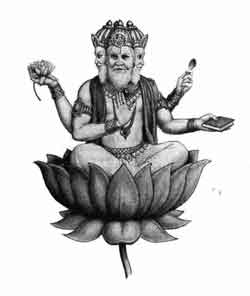
image: Brahmin from www.kamat.com

20 August 2010

A Parody of Vedic Belief

Professor Richard Gombrich has been at the fore-front of pointing out that late Vedic beliefs are parodied in the Buddhist scriptures. [1] He has demonstrated in a series of erudite articles that the Buddha must have known the body of teachings that underlie the early Upaniṣads - especially the Bṛhadāranyka (BU) and Chāndogya (CU). This is not to say that these actual texts would have been known to him, because most scholars believe them to be later distillations anyway (rather like the Buddhist texts), but that the beliefs we read in them were known. What kinds of evidence do we have for this thesis? I've been researching what kinds of views we find in the mouths of Brahmins in the Pāli texts and hope at some point to publish the results. My finding so far is that no Brahmin appears to espouse the kinds of views about ātman/brahman that we would associate with the Upaniṣads. However we do find something like those views being put into the words of Brahmā (i.e. God) himself for instance in the Kevaddha Sutta. [2]

In the BU 1.4.10 we find this passage (Olivelle's translation)
In the beginning this world was only brahman, and it knew only itself (ātman), thinking: "I am brahman." As a result it became the whole. Among the gods, likewise, whosoever realized this, only they became the Whole. It was the same also among the seers and among the humans. Upon seeing this very point, the seer Vāmadeva proclaimed: "I was Manu, and I was the sun." This is true even now. If a man knows "I am Brahman" in this way, he becomes this whole world.
Anyone interested in the Sabba Sutta should pay close attention to this verse as this is also the context for that sutta - Olivelle's 'Whole' is a translation of Sanskrit sarvaṃ = Pāli sabbaṃ - but for this essay I want to draw attention to the phrase "I am brahman": ahaṃ brahmāsmi. This is seen by Vedic believers as a kind of credo. It sums up the path according to the sages of the Upaniṣads which is that the realisation that you are brahman is the highest realisation. In this realisation one becomes this whole world (sa idaṃ sarvaṃ bhavati).

In the Pāli Kevaddha Sutta the householder Kevaddha approaches the Buddha to encourage him to perform some miracles and thereby attract followers. The Buddha says that not how he operates. How he does operate is spelled out in the long passage that is repeated in all 13 of the first of the Dīgha Nikāya suttas, but this segues into a story of a monk who, desiring to know where the elements cease without remainder. In order to answer the question he attains super human states of consciousness in meditation and visits the realms of the various devas, moving up the scale until me meets Brahmā himself. Posed the question Brahma can only reply:
"ahamasmi, bhikkhu, brahmā mahābrahmā abhibhū anabhibhūto aññadatthudaso vasavattī issaro kattā nimmātā seṭṭho sajitā vasī pitā bhūtabhabyānan" ti.

"I am, bhikkhu, Brahmā, Great Brahmā, unconquered conqueror, omnipotent, Lord over all, maker and creator, the highest, controller of the cosmic order, and father of all beings past, present and future."
Note that Brahmā doesn't answer the question. It turns out that he doesn't know the answer, but has to keep up appearances because the other gods believe it is true that Brahmā is the omnipotent creator. He takes the monk to one side to explain this and point him back in the direction of the Buddha.

But notice how he starts his answer. If we leave out the 'bhikkhu' he says: ahamasmi brahmā. Compare this to the Sanskrit: ahaṃ brahmāsmi. That the Pāli is a reference to the BU, or at least to the body of teaching recorded in that text, is clear. Although the BU was not written down for many years after the Buddhist texts, the scholarly consensus is that BU represents a body of teachings that predate the Buddha by several centuries. Given the flexibility of syntax in the two languages we are looking at the same statement. Exactly the same except that the Sanskrit has an ambiguity - brahmāsmi can be read as brahma asmi or brahmā asmi i.e. as the neuter or masculine. The first is the abstract universal essence of the cosmos that manifests as ātman in the individual; the second is the masculine creator god. The first usage in BĀU 1.4.10 is the context of a neuter pronoun 'it' (tad), while the second is in the context of a masculine pronoun 'him' (sa), so both senses could be being used here! Gombrich observes that the Buddha has selected the less abstract, and therefore less sophisticated, of the two, i.e. Brahmā as creator god, and that this helps to contribute to the overall sense of this being not just a polemic, but a parody. Johannes Bronkhorst has been very critical of Gombrich's interpretation of this kind of reference as evidence of the Buddha's sense of humour, [3] but personally I think this example is funny. On the one hand the realisation "I am Brahmā" encapsulates the highest goals of religion; and on the other the statement is just an egotistical and deluded claim with no basis.

The ideal of union with Brahmā (brahmasahavyatā) is also found in the Tevijja Sutta (DN 13) where we find the Buddha informing some hapless Brahmins Vāseṭṭha and Bhāradvaja [4] that though there own teachers are ignorant of the way leading to this goal, that:
brahmānaṃ cāhaṃ, vāseṭṭha, pajānāmi brahmalokañca brahmalokagāminiñca paṭipadaṃ
I know Brahmā, Vāseṭṭha, and Brahmā's domain, and the way leading to Brahmā's domain.
The Buddha then teaches the meditations we have come to know as the brahmavihāra 'dwelling with Brahmā', though the name is not used here. Brahmavihāra is actually a synonym of brahmasahavyatā. It would be like walking into a Christian church and asking "How many of your priests have been face to face with God? None? I have, and I can tell you how to be in His presence. You don't have to die and go to heaven, you can dwell in heaven right now!" - and teaching the mettābhāvanā! I've often wondered what would happen if we took the Buddha's approach to theistic religion. Forget about opposition and proving that God exists, but just roll with it and teach Buddhism in Christian terms. I think most of us are too afraid of losing our religion, and perhaps lack confidence in our methods, to even try this. And, of course, it would require one to be truthfully in that state of dwelling with God (brahmavihāra). But it is what the Buddha appears to have done.

To those people who claim that Buddhism is a religion which tolerates all views this must come as a shock. Not only did the Buddha not tolerate wrong views, he actively went about subverting them and making fun of people who held them. There are times when the Buddha of the Pāli Canon makes Richard Dawkins seem like an appeaser.


Notes
  1. Professor Gombrich's contribution is summed up in his book What the Buddha Thought. References to his individual papers can be found there. The observations I make here has been observed by him previously, but I'm putting them in my own words.
  2. also Kevaṭṭa Sutta. Dīgha Nikāya 11. PTS D i.211. Translation that follows is mine. Pāli text from CST.
  3. Especially in his book Greater Magadha: Studies in the Culture of Early India.
  4. These two show up in various retellings of this story at e.g. DN 13, MN 98, and Sn 3.9. I haven't yet done a detailed comparison, but I'm working on it.
image: Brahmā from adishakti.org

13 August 2010

A Pāli Verse

Kalahavivāda Sutta - Sutta-nipāta, verse 876I've been working on Pāli texts a lot lately. Every now and then I throw caution to the wind and try something from the Sutta-nipāta - the oldest part of the canon, but also some of the most difficult grammar and syntax, and mostly in verse. After quite a bit of work, consulting first the commentaries and then K.R Norman's translation notes I managed to sort out Sn 876 which is the second to last verse of the Kalahavivāda (Quarrels & Disputes) Sutta (Sutta-nipāta iv.11). Since this was quite involved I thought my notes might give some insights into some of the difficulties one finds in translating. The Pāli is:
a|Ettāvataggampi vadanti heke,
b|yakkhassa suddhiṃ idha paṇḍitāse;
c|Tesaṃ paneke samayaṃ vadanti,
d|anupādisese kusalā vadānā.
The verse is in reply to a question from what seems to be an anonymous group of people. These 'suttas' are not introduced by Ānanda saying 'evaṃ me sutaṃ', nor do they set the scene, so the context is obscure. However the earlier part of the sutta is questions about dependent arising and desire. All of the questions on this subject are answered, then the interrogators say they have one more question. Since the answer is phrased in terms of the question, it should become clear what the question was as we proceed.

Firstly some Pāli lexiography/morphology needs to be explained
  • ettāvataggampi is most likely ettāvata aggaṃ api
  • heke is an Eastern, or Māgadhan, form of eke 'some' (nominative plural). [1] This form is not in PED.
  • paṇḍitāse is according to Norman a nominative plural "there can be no doubt that -āse is derived from the Vedic -āsas ... and -e < -as is an Eastern form, sometimes called a Māgadhism". (note 7, p.150; note 876 p.362)
  • paneke had me foxed for a while until I saw the sandhi. It is pan' eke or pana eke.
  • vadānā is a form which is in PED. It derives either from the ātmanepāda or the passive form of √vad (PED sv vadati towards the bottom of the entry). It is a present participle with the meaning 'being called, so-called). Ireland mistakes it for vadana 'says'. And Norman and Thanissaro translate 'who say they are' rather than 'are called', i.e. they give it a clearly active reflective sense of 'call themselves'. Norman references the Critical Pāli Dictionary entry on anupādisesa which says "i. e. those who pretend to be 'an-upādi-sesa' kusalavādā samānā, Pj = Nidd-a;". [2]
So note the predominance here of 'Eastern' forms which do not become standard Pāli, but fade out of use. These are not the kind of differences that would make Eastern and Western dialects mutually incomprehensible. Just minor differences like a Londoners dropping their h's (ironically pronounced haitch) or making the 'd' in London a glottal stop: Lon'on.

From here working out the cases and conjugations is relatively straight forward. However this is verse and so the syntax is more difficult to work out. I like to look for words in the same case, as these words usually go together. So clearly heke and paṇḍitāse go together: 'some of the wise'.

Putting it altogether took quite a lot of thought. In pada's a & b clearly heke paṇḍitāse vadanti is a unit 'some of the wise say'. If we ignore for the minute the indeclinables we find yakkhassa suddhiṃ aggaṃ. This could be 'the highest purity of the yakkha'. However we now bring in ettāvatta 'so far, to this extent', we find other possibilities. The sentence could be 'the highest purity of the yakkha is to this extent' (Norman adds ...[only] to this extent). The English is not very good, but the sense would seem to be that the highest purity of the yakkha only goes so far.

Perhaps it would help us to know who or what the yakkha is? Thanissaro and Ireland (see below) translate this as 'the spirit', which seems to me to give entirely the wrong connotation in English. It allows the reader to think in terms of their own 'spirit' (in a New Age sense), or in terms of 'spirits'. Yakkha could at the outside be 'a spirit' but not 'the spirit'. I think yakkha here is the Buddha, spoken of in the abstract - i.e. the ideal person. [3] In the sutta immediately previous to this (Purābheda Sutta: Sn iv.10) the subject is the uttamaṃ naraṃ 'supreme man', another synonym for the religious ideal. The one before that (Māgandiya Sutta iv.9) discusses purity and characterises the ideal man as a 'nāga'. In the Pasūra Sutta (iv.8) the ideal is dhona - a word of doubtful etymology, but meaning 'purified'. The Buddha is also called ādiccabandhu 'kinsman of the Sun' (surely a Vedic term!) and mahesi (i.e. mahā-ṛṣi) 'great seer'. The context here is people from various religious backgrounds asking the Buddha questions about religious ideals. Some of the pre-, or non-, Buddhist terminology they use is carrying over, though not all of it is retained by Buddhists. [4]

So the question could be about the extent to which purification is possible, and the Buddha in his reply is saying "yes, some people think purity is limited", i.e. that no escape from saṃsāra is possible (this was the view of some Brahmins for instance). Another way to view the phrase is to see it as being about the extent of purification of the Buddha himself. Norman translates "...that the supreme purity of the yakkha is to this extent [only]..." (p.115) So if the yakkha is the Buddha then the question might not be abstract, but concrete. They might be asking about the Buddha's own state. However the following verse is very much phrased in abstract terms. Where to slot the idha 'here' is a minor problem, though as perplexing as all the rest. I put it where it seems to make most sense in English, but this is probably the foible of an amateur!

If you look at the accompanying image you will see that I've mapped out the flow of the sentence as I understand it (I had to do this to understand it!). I think pada a& b say:
some here who are wise say that,
the purity of the yakkha is highest to this extent [only].
Pada's c & d are hardly less puzzling. But if we work through it, order emerges. We have a pronoun in the nominative plural (eke) along with a verb in the 3rd person plural (vadanti) so this means 'some say'. The pronoun tesaṃ (plural dative or genitive) seems to fit: 'some of them'. Also in the nominative plural we have kusalā vadānā giving us 'some who call themselves experts say'. Now anupādisese looks like an accusative plural and samayaṃ looks like an accusative singular, though Norman says "there is no reason we should not take [anupādisese] with samayaṃ".

I haven't mentioned these last two words before so let's do it now. Anupādisesa is a compound of a + upādi + sesa: and means not (a) having fuel (upādi) remaining (sesa). This references the fire metaphor and suggests someone who has not only extinguished the fires of greed, hatred and delusion, but who has no more fuel on which they might be reignited. Much was later made of this distinction by Theravāda exegetes, but I think it simply makes a distinction between a living Arahant (who still has the fuel of his senses, which could potentially fuel a fire) and the state of an Arahant after death when no more fire is possible. The -e ending is not explained by Norman or other authorities (so perhaps it was obvious to them, and not to me). Other translators seem in fact to take it as an accusative singular.

Samayaṃ can mean 'time' or 'condition'; or sometimes 'congregation'. Now, the commentator in the Sutta-nipāta-aṭṭhakatha (aka Paramattha-jotikā II) glosses samayaṃ by ucchedaṃ - ie. reads it as a statement of nihilism. Not even the redoubtable Mr Norman can make sense of this! It more obviously suggests that the so-called experts say there is a 'time for' or 'condition of' anupādisese, i.e. of no-fuel-remaining, or complete liberation from greed, hatred, and delusion.

The next verse is an elaboration of the Buddha's view in terms of understanding that experience is dependent on contact etc. It expands on the theme of anupādisese rather than introducing a whole new topic.

So my whole translation then is:
Some here who are wise say that:
The purity of the yakkha is the best to this extent [only].
However, some of them who call themselves experts reply
It is the condition of no-fuel-remaining.
By way of contrast here are some other translations.

Norman:
"Some wise men here do say that the supreme purity of the yakkha is to this extent [only], but some of them, who say they are experts, preach that there is a time for [quenching] with no grasping remaining." [5]
John Ireland
"Some of the learned do declare purification of the spirit as the highest. But contrary to them some teach a doctrine of annihilation. Those clever ones declare this to be (final liberation) without basis of life's fuel remaining" [6]
Bhikkhu Thanissaro
"Some of the wise
say that just this much is the utmost,
the purity of the spirit is here.
But some of them,
who say they are skilled,
say it's the moment
with no clinging remaining." [7]
Dhīvan
This is what some clever people say about it,
that the purity of the individual is best to this extent.
But some of them, who call themselves experts,
teach that there comes a time when there is no grasping left. [8]
~~||~~

Notes
  1. I think this is with reference to forms that appears in Aśokan and later inscriptions. These showed dialectical variations like heke/eke.
  2. Cf Sn 888: Yeneva bāloti paraṃ dahāti, tenātumānaṃ kusaloti cāha; Sayamattanā so kusalo vadāno, aññaṃ vimāneti tadeva pāva. Norman: "on account of what he considers his opponent to be a fool, on that account he calls himself a expert. Calling himself an expert, he despises the other, [and yet] he speaks in that very same way." (pg.116)
  3. Norman tacitly acknowledges that yakkha refers to the Buddha (just as Nāga often does) in his note to verse 478 (p.260) and says he prefers to leave it untranslated, though without saying why (which is a rare omission for him). An interesting question is in what culture was a Yakkha (S. Yakṣa) seen as a high status being? Certainly not in Vedic culture, and not in later Buddhist culture.
  4. I note in passing that none of these discussions are in terms of ātman or brahman. I have been wondering lately whether there are any discussions in the Pāli which directly reflect these concerns.
  5. Norman reads upādi as 'grasping', but cf PED sv upādi "= upādāna, but in more concrete meaning of "stuff of life", substratum of being, khandha; only in combn. with ˚sesa (adj.) having some fuel of life (= khandhas or substratum) left, i. e. still dependent (on existence), not free, materially determined". By contrast CPD merely has: 'attachment'.
  6. Ireland's notes point out that "The term 'spirit' (yakkha) is equivalent here to 'being' or 'man." I don't think translating "the spirit" conveys this. (see also note8) Note also that Ireland follows the commentary in taking samayaṃ as 'nihilism'.
  7. Thanissaro also opts to translate yakkha as 'the spirit' (see comments in note 6 and 8 and in the text) and upādi as 'clinging'.
  8. Dhīvan's rendering of yakkha as 'individual' is interesting here - it universalises the statement without creating the kinds of problems introduced by terms such as 'spirit'. This is supported by PED sv yakkha (7): "Exceptionally the term 'yakkha' is used as a philosophical term denoting 'individual soul'... "ettāvatā yakkhassa suddhi (purification of the heart)".

References

Pāli texts
All from Chaṭṭha Saṅgāyana Tipitaka Version 4.0 (CST4).
  • Kalahavādasuttaṃ. Sutta-nipāta (PTS Sn 876).
  • Kalahavivādasuttavaṇṇanā, Suttanipāta-aṭṭhakathā (PTS Pj ii.550f)
  • Kalahavivādasuttaniddeso, Mahāniddesapāḷi (PTS Nidd I i.254f)
Translations
  • Dhīvan. Kalahavivādasutta Discourse on Quarrels and Disputes (triṣṭubh). Unpublished translation.
  • Ireland, John D. (trans) "Kalaha-vivada Sutta: Further Questions"(Snp 4.11). Access to Insight, June 14, 2010, http://www.accesstoinsight.org/tipitaka/kn/snp/snp.4.11.irel.html.
  • Norman, K.R. (trans) The Group of Discourses (Sutta-Nipāta). 2nd ed. Pali Text Society, 2001. [Norman's notes supply relevant sections from the commentaries in the Mahāniddesa (Nidd I) and the aka Paramattha-jotikā II (Pj II).]
  • Thanissaro. (trans) 'Kalaha-vivada Sutta: Quarrels & Disputes' (Snp 4.11). Access to Insight, June 8, 2010, http://www.accesstoinsight.org/tipitaka/kn/snp/snp.4.11.than.html.

06 August 2010

What Did the Buddha Mean by 'World'?

earth in handsI have been working on a commentary to the Kaccānagotta Sutta (SN 12.15, PTS Sii.16.) and considering the term loka, usually translated as 'world', and how the Buddha used it; especially in the context of the compound lokasamdaya 'origin of the world'. In my research I found a trail already followed by Bhikkhu Bodhi in the notes to his Saṃyutta Nikāya translation. I will work through these texts myself, offer my own translations and observations, but leave Bhikkhu Bodhi the last word, since he got there before me.

Our first text is the Discourse of Going to the End of the World. [1] Here an odd question is raised:
kena cāvuso lokasmiṃ lokasaññī hoti lokamānī?
And by what, friend, in the world is one a perceiver and cogniser of the world?
The answer is that one is a perceiver and cogniser of the world by the six sense organs in the world. On one hand this is obvious - one perceives 'the world' through the senses - however the senses themselves are in the world (lokasmiṃ). Bhikkhu Bodhi points to SN 2.26 for an explanation. This is the Rohitassa Sutta. [2] Here the young deva, Rohitassa, asks the Buddha:
yatha nu kho bhante na jāyati na jīyati na mīyati na cavati na upapajjati, sakkā nu kho so, bhante, gamanena lokassa anto ñātuṃ vā daṭṭhum vā pāpuṇituṃ vā ti?

Is there a way by travelling to know, or see, or to reach, the end of the world where one is not born, grow old, die; where is is no death and rebirth?
The answer is no. One cannot reach the goal by actually travelling. I take this to mean that the Buddha is not talking about a place, that the language of the 'path' is only a metaphor. So the world being talked about is not the physical world, not the external objective world. He then makes a statement which might be familiar:
Na kho panāhaṃ, āvuso, appatvā lokassa antaṃ dukkhassa antakiriyaṃ vadāmi. Api ca khvāhaṃ, āvuso, imasmiṃyeva byāmamatte kaḷevare sasaññimhi samanake lokañca paññapemi lokasamudayañca lokanirodhañca lokanirodhagāminiñca paṭipadanti.

However, I, friend, there is no making an end of disappointment, without reaching the end of the world. And, friend, it is right here in this 'fathom long' [3] body endowed with perception and cognition that I declare the world, the origin of the world, the cessation of the world, and the way leading to the cessation of the world.
So this reinforces the idea that 'the world' is not 'the world' as we usually think about it, but the kind of world we refer to when we refer to some who "lives in a world of their own" - a subjective world. If we turn to Buddhaghosa's commentary [4] at this point (as Bhikkhu Bodhi does in his notes) we find that he links loka with dukka and associates the four truths of the noble ones with the world, the origin and cessation of the world and the way to the cessation of the world. Buddhaghosa then says:
Iti – ‘‘nāhaṃ, āvuso, imāni cattāri saccāni tiṇakaṭṭhādīsu paññapemi, imasmiṃ pana cātumahābhūtike kāyasmiṃ yeva paññapemī’’ti dasseti.

Thus he should see: ' I do not, friend, declare these four truths in grass and wood, but I declare them only in this body of the four great elements'.
Now this is presented as a quote from the Buddha, but modern databases make it easy to show that it does not occur in the Pāli texts that have come down to us. So we must be cautious in how we use it. With this caveat I may say that this the most unequivocal statement that the Buddha is unconcerned with the objective world, but only with the subjective world, that I know of. What in effect Buddhaghosa, at least, is saying is that paṭicca-sammupāda is not intended to apply to the external world, but to one's world of experience - to the processes of perception (the senses) and cognition (the mind) located within the body.

In the World Sutta [5] the Buddha asks the rhetorical question: "what is the origin of the world". His answer is a well known formula:
Cakkhuñca paṭicca rūpe ca uppajjati cakkhuviññāṇaṃ. Tiṇṇaṃ saṅgati phasso. Phassapaccayā vedanā; vedanāpaccayā taṇhā; taṇhāpaccayā upādānaṃ; upādānapaccayā bhavo; bhavapaccayā jāti; jātipaccayā jarāmaraṇaṃ sokaparideva-dukkhadomanassupāyāsā sambhavanti. Ayaṃ kho, bhikkhave, lokassa samudayo.

With the eye and forms as condition, eye-consciousness arises. The coincidence of the three is contact. On the basis of contact there are sensations, which give rise to desires. Desires are fuel which supports becoming. [6] With becoming there is birth, and from birth old-age, and death, grief, lamenting, misery, dejection, and trouble are produced. This, monks, is the origin of the world.
This is a portion of the nidāna chain (the most useful and relevant part) which we normally associate with the arising of dukkha. Here the world is more or less equivalent to dukkha. Note that 'the world' comes into being on the basis of contact between sense organ and sense object - forms. Here forms are not part of 'the world', they are part of the conditions which give rise to the world - this is a very important distinction. The nidānas do not give rise to forms, they give rise to the experience, the world of suffering.

The conclusion of this exploration is, I hope, clear and I will leave it to Bhikkhu Bodhi to articulate it:
"The world with which the Buddha's teaching is principally concerned is 'the world of experience,' and even the objective world is of interest only to the extent that it serves as that necessary external condition for experience" [7]

~~||~~

Notes
  1. Lokantagamana Sutta (SN 35.116, PTS S iv.93)
  2. Rohitassa Sutta (SN 2.26, PTS S i.61; also AN 4.45, PTS A ii.47)
  3. 'fathom long carcass' is (I think) Mrs Rhys David's translation of byāmamatte kalebara which has a great ring to it: but byāma refers to 'an arm-span' which is typically somewhat less than a fathom or six feet. Kaḷevara (or kaḷebara) is 'the body'. It also means 'a corpse or carcass', but a dead body is seldom "endowed with perception and cognition"
  4. Rohitassa Sutta Vaṇṇanā (SA i.116)
  5. Loka Sutta (SN 12.43, PTS S ii.73)
  6. upādāna is typically translated as 'clinging'. This is neither bad doctrine, nor bad philology. However Richard Gombrich has shown how the word more literally means 'the thing which supports a active process' i.e. fuel. The equation that "desire fuels becoming" is part of the metaphor of fire, which characterises becoming (bhava) as like a fire which can only continue when there is fuel. In my opinion it makes more sense. I've written more on the use of the metaphor of fire in these essays: Everything is on fire! and Playing with Fire.
  7. Bodhi. Connected Discourses p. 394, n.182.

image: earth in hands from Worthington Libraries.

30 July 2010

Some Additional Notes

Here are two follow up notes to previous essays, one on the -e ending in mantras, another on the name Gotama; and lastly a brief note on dating the Canon.


1. The -e Ending in Mantras.

In March 2009 I wrote Words in Mantras That End in -e. In that essay I revisited some of the ideas about what the -e ending might signify, especially with respect to the Heart Sūtra mantra. Kern, Conze and other Sanskritists have seen it as a feminine vocative singular, though of course there are other grammatical possibilities. [1] I speculated that the -e ending was simply a masculine nominative singular, and that the mantras were composed in a region of India which employed that ending as opposed to Classical Sanskrit -as/-aḥ or Pāli -o. Recently I stumbled on an article by Signe Cohen which adds something to the picture. I know Cohen from her excellent linguistic analysis of the Upaniṣads: Text and Authority in the Older Upaniṣads. This book is particularly important for the understanding it brings of the internal struggles apparent especially in the Bṛhadāranyka Upaniṣad which has Yajurveda sages in direct competition and victorious over Ṛgveda sages. However in 2002 Cohen published a short article on the -e ending:
On the Buddhist Hybrid Sanskrit/Middle Indic Ending "-e" as a 'Magadhism', Acta Orientalia Vol. 63 (2002), p.67-9.
This article points out that although the -e form for the masculine nominative singular does indeed occur in the North East of India, it is in fact far more widespread. This has partly been obscured as editors of Sanskrit texts have 'corrected' the text for critical editions. Patrick Olivelle complains of the same problem with the Upaniṣads in his article:
'Unfaithful transmitters: philological criticism and critical editions of the Upaniṣads,' in Language Texts and Society, Firenze University Press, 2005. (p. 285f) [originally published in Journal of Indian Philosophy 26, 1998: 173f.]
Western Editors, believing Indian pandits to be incompetent, silently emended unusual spellings. However as Olivelle points out, those pandits were far from incompetent, likely to be well versed in Pāṇini, and to know a 'wrong' form when they saw one. Indian scholars tended to preserve dialectical and archaic variants, being inherently more conservative in relation to texts they saw as sacred. To the European scholar of a certain era nothing but their own objectivity was sacred. While we may not accept the pandits explanations of such variant forms (which are frequently ascribed to the peculiarities of Vedic or given mystical significance) they were at least not so over-confident as to 'correct' them. As such, modern critical and printed editions of the Upaniṣads often obscure the history of the text by removing evidence, and reproducing previously corrected texts without question.

Cohen notes that in fact the -e form is found all over North India, and especially in Sanskrit loan words in Tocharian. She concludes:
"The common assumption that the -e ending is an Eastern Dialect form must be seriously questioned. Rather than being a specifically Eastern Dialectical feature found sporadically in other parts of India due to eastern influence, it appears that the -e ending was widespread, especially in Buddhist Sanskrit, that it must be considered a standard form, next to the -o ending." [p. 68; my italics]
My conjecture is that Buddhist mantras were composed in Prakrit or Buddhist Hybrid Sanskrit rather than Classical Sanskrit, and that words ending in -e in mantras are simply nominative singular forms, the gender of the words in the mantra having no relationship to the gender of the deity - and in the case of the Heart Sūtra there is no deity anyway.

~~~~

2. The Name Gautama

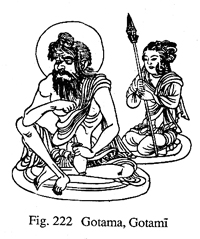
In my essay What Was the Buddha's Name? I drew attention to the quirk of history which left the Buddha, a kṣatriya by tradition but possibly a non-āryan, with an ostentatiously Brahmin gotra-, or clan-name: Gautama (meaning 'descended from Gotama, the one with the most cows go'). However more than half a century ago D.D. Kosambi offered a different take on this subject in a review published in 1953:
D.D. Kosambi. 'Brahmin Clans'. Journal of the American Oriental Society, Vol. 73, No. 4 (Oct. - Dec., 1953), pp. 202-208.
He points to two brief Pāli passages which suggest that Gautama (Pāli: Gotama) is not the Buddha's gotra name. The first is from the Therīgāthā verses of the Buddha's maternal aunt and foster mother. She says (Th 2 162)
Bahūnaṃ vata atthāya, māyā janayi gotamaṃ;

Truly for the many, Māyā gave birth to Gotama
Kosambi's point here is that the names Māyā and Gotama are on the same level - i.e. they are both first names. This is to read the text quite literally, and I'm a bit doubtful about doing that. Compare for instance the case of the Brahmin boy Uppatissa, son of Rūpasārī, better known as Sāriputta 'son of (Rūpa)sārī'.[2] However Kosambi points out that neither does the Buddha's wife become known as Gotamī in any tradition. The fact that Mahāpajāpati, his mother's sister, is called Gotamī also suggests that it is not the Buddha's clan-name since the names pass pass down patrilineally (though I think Kosambi here is thinking in terms of Brahminical social rules which required Brahmins to marry outside their gotra). Kosambi also notes that bhikkhus are sakiyaputta not gotamaputta. He does not attempt to explain why the future Buddha might be named after Vedic sages however, which still strikes me as odd.

Kosambi's other text is the Pabbajjā Sutta [Sn 3.1] in which King Bimbisāra asks the Buddha where he is from. The Buddha replies that he comes from the country of Kosala, and:
Ādiccā nāma gottena, sākiyā nāma jātiyā;
Tamhā kulā pabbajitomhi, na kāme abhipatthayaṃ.

Called Ādiccā by clan, called Sākiya by caste [jāti]
I went forth from that family, not longing for pleasures.
The phrase only occurs once in the canon, but elsewhere the Buddha says that the Sākiya consider rājā okkāka their ancestor [Ambaṭṭha Sutta, DN 3, PTS D i.92-3] and Pāli okkāka is Sanskrit ikṣvāku a king of the ādityā [P. ādiccā] gotra. The suggestion then is that the Buddha's name was in Sanskrit Gautama Ādityā; and Pāli Gotama Ādiccā. The Buddha is also sometimes called Āṅgirasa which according to the Dictionary of Pāli Names was a tribe which included the Gautama gotra. My reading of some of the DOPN references suggests that āṅgirasa was being used as an adjective (e.g. 'shiny like the sun') rather than a name. Against the passage above Kosambi also cites the Mahāpadāna Sutta [Dn 14, PTS ii.3]
Ahaṃ, bhikkhave, etarahi arahaṃ sammāsambuddho gotamo gottena ahosiṃ.

I bhikkhus, now worthy, fully awakened, was of the Gotama gotra. [3]
This phrase occurs 3 times in the suttas, all in the Mahapadāna. Kosambi refers to this as "the first interpretation of Gotama as the Buddha's gotra name... obviously a late formation under Brahmin influence". Indeed it is so obvious that Kosambi provides no evidence for his conjecture, nor does he consider the possibility that both statements about gotra are "late formations". Contrarily we find the name Gotama being used in the last two chapters of the Sutta-nipāta which are generally considered to be the oldest layers of the Pāli Canon.

It is still a puzzle as to why the Buddha even has a gotra name, let alone a Brahmin one (which both Gautama and Ādityā are). He was not a Brahmin. I don't think Kosambi solved the mystery, but he provided an interesting additional view point. One last observation of my own is that though the Buddha meets Brahmins from many other gotra lineages, he never seems to meet a Gautama Brahmin. This is despite the fact that the two ancestors Gotama and Bharadvāja are mentioned together in Bṛhadāranyka Upaniṣad 2.2.4, and Gautama the Buddha meets more than a dozen Brahmins from the Bhāradvāja lineage, who mostly seem to live in Kosala (see e.g. DN 3, 13, 27, 32, but throughout the nikāyas).

18 Aug 2011
I've been looking at Brahmins in the Canon and thinking about the Buddha's Brahmin surname. No other males with the gotra name "Gautama" are found in the Pāli Canon, though there are several women. I think the facts we have might be explained if the Buddha's mother and her sister were of the Gautama clan, and married Sudhodana who was a Śākya. Gautama in other words is actually Gautamaputra, Son of Gautamī; on the same model as Śāriputra is the Son of (his mother) Śārī.


6 Sept. Extra note

Snodgrass, vol.2 p. 471
In the Garbhadhātu Maṇḍala of the Shingon school, associated with the Mahāvairocana Abhisaṃbodhi Tantra (MAT), there is a figure called Gautama (or Gotama; Japanese: Kudonsen 瞿曇仙). This is the Vedic Gautama and he attends on the god Agni. Adrian Snodgrass suggests that he is the subject of many hymns in the Ṛgveda, though this is not correct as far as I know. He is, however, credited as the author of some of them. Snodgrass translates from Dainichikyōsho (Śubhakarasiṃha's commentary on the MAT):
"The hermit-ascetic Gotama [sic], flying in the sky at well, let fall two drops of sweat upon the earth, and the earth gave birth to sugar cane. Warmed by the sun, the sugar cane gave birth to two children, who became Śākya kings"*
These two are the progenitors of the clan which 'Siddhartha' was born into. Gautama has a consort called Gautamī. I have not yet found the connection between the 'sugar cane' clan (Kansho) and the Śākya clan, though it may rest on a Chinese (mis)translation. In any case it that MAT includes the Vedic Gautama alongside the many other Vedic gods and important figures. Note that this story glosses over the fact that Gautama is a brahmaṇa, while the Buddha is usually referred to as a kṣatriya.

* see Snodgrass, Adrian. The Matrix and Diamond World Mandalas in Shingon Buddhism, vol. 2, p. 470.


~~~~

3. Dating the Canon.

The Assalāyana (MN 93) is a lengthy discussion between the eponymous Brahmin and the Buddha about the claim by Brahmins to be the best class (brāhmaṇo'va seṭṭho vaṇṇo). [4] Amongst the various arguments the Buddha puts forward is the relativist argument that some countries only have two classes, viz. ayyo and dāsa, i.e. noble and slave. [MN 93.5] These two countries (janapada) referred to are Yona and Kamboja. Various maps put Kamboja in different places, but it was supposedly north and west of Gandhāra. Shrimali centres it on the Kabul River (which flows through the Hindu Kush mountains from what is now Afghanistan to join the Indus) [5] Yona is thought to refer to Bactrian Greeks even further west. As the DOPN says:
The name is probably the Pāli equivalent for Ionians, the Baktrian Greeks. The Yonas are mentioned with the Kambojas in Rock Edicts v. and xii of Asoka, as a subject people, forming a frontier district of his empire.
These Greeks are thought to have been descendants of garrisons left by Alexander of Macedon. And this gives us our date. [6] At the time of the Buddha the Persian Achaemanids ruled as far east as the Indus River - i.e. including Gandhāra. We can confidently date Alexander's Indian campaign as part of his assault on and destruction of the Achaemanid Empire, to 327-326 BCE. If yona means 'Greek', then MN 93.6 cannot have been written before this date. Dates of the Buddha are less certain but the most recent research points to his death being circa 400 BCE, some 70 odd years before Alexander. Greek cultural influence remained for some time with post-Mauryan Dynasty Gandhāra being ruled by what is termed an 'Indo-Greek' dynasty from ca. 180 BCE - 10 CE. Greek aesthetic ideals heavily influenced Gandhāra art for some centuries, so that the first anthropomorphic images of the Buddha, produced in that region during the Kushan period (ca. 75-241 CE) showing obvious Hellenistic features.

Note 7 May 2017 - to the best of my knowledge the Greeks never used Ionian as a general label. It was always a specific reference to Greeks who lived in Ionia - modern day Turkey. Moreover, the Greeks in question were Macedonians from Macedonia and that is probably how they referred to themselves. However, the Persians may have used Ionian as a general term for Greeks. If the Pāḷi Canon is using a Persian term for Greeks then this suggests that it was incorporated before Alexander. In which case the date goes back to being very vague indeed. 

~~||~~

Notes
  1. for instance -e can signify a masculine or neuter locative singular of a noun or past-participle in -a, such as gata (past-participle of gacchati).
  2. I don't want to multiply examples needlessly but Moggallana's given name was Kotila (after his village, just as Upatissa was called after his village). Kassapa (tortoise) is a very common name in Pāli perhaps because it was a gotra name as well. It seems that calling people by clan or family names, or epithets was a common practice.
  3. Note that Walsh translates this as a present (I am) when the verb is clearly past-tense; the Buddha left his clan, class, and caste behind when he went forth.
  4. D ii.148. Note that he continues "the other class is defective" (sometimes in this pericope the plural is used 'the other classes'). The Pāli being: hīno añño vaṇṇo. Here the term hīna is clearly being used pejoratively in a caste context. See also my Hīnayāna Reprise.
  5. Shrimali, Krishna Mohan. The Age of Iron and the Religious Revolution : c.700-c.350 BC. (A People's History of India: 3A). New Dehli, Tulika Books. 2007. Map p.85.
  6. I haven't found any reference to this fact, but I presume someone else has already noticed this.

23 July 2010

The Buddha's Refuge

DharmacakraA lot of the Buddha's biography seems to be in the form of psycho-drama. His internal processes get acted out, and the 'players' are a variety of archetypal characters including Māra ['the killer'] and Brahma-sahampati [God] and the Earth Goddess [Pṛthvī]. Often the Buddha is shown as considering a dead end before coming up with a brilliant but previously unforeseen solution. In a brief episode found in the Saṃyutta Nikāya, the Gārava Sutta, [1] the Buddha is faced with a dilemma in the aftermath of his breakthrough to awakening:

dukkhaṃ kho agāravo viharati appatisso, kaṃ nu khvāhaṃ samaṇaṃ vā brāhmaṇaṃ vā sakkatvā garuṃ katvā upanissāya vihareyyanti?

Miserable indeed the disrespectful and rebellious dwell. Which ascetic or priest should I reverence, respect, and dwell in subordination to?
The Buddha then considers whether there is anyone more developed than himself to which he could subordinate himself to. But he sees no-one more accomplished than himself in virtue, meditation, wisdom (i.e. the three-fold path); nor in liberation or the knowledge and vision of liberation. In short he sees no one in any realm to whom he could be a subordinate - not even amongst the gods. Then he decides:
Yaṃnūnāhaṃ yvāyaṃ dhammo mayā abhisambuddho tameva dhammaṃ sakkatvā garuṃ katvā upanissāya vihareyyanti.

I will reverence, pay my respects, and dwell in subordination to that very thing to which I have fully-awakened.
At this point Brahma-sahampati turns up to praise the Buddha for his decision. He reveals that this is what all the Buddhas of the past have done, and all the Buddhas of the future will do.

This is a pretty literal account and partial translation of the text. I wanted to convey the raw experience of reading the text in Pāli. But in taking this approach I must then retrace my steps and say more about the context. Indian society, like most societies, was and is hierarchical. We are probably familiar with the ideas of class (varṇa) and caste (jāti). Each person was embedded in a web of social links and obligations. The Chinese called awareness of, and obedience to, this aspect of life: filial piety (; xiào). One had obligations to one's parents for instance, to one's spouse and children, and to the king. Another hierarchy existed in religious circles which may have been modelled on social norms. A student lived, as they say, at the feet of their teacher. In taking a teacher one became their disciple, their servant, and one obeyed without question every instruction. Compare this passage from the Visuddhimagga:
Ācariyassa niyyātentenāpi ‘‘imāhaṃ, bhante, attabhāvaṃ tumhākaṃ pariccajāmī’’ti vattabbaṃ.

Dedicating himself to a teacher he should say: "I give up this personality [attabhāva] to you, Sir." (Vism iii.126)
Regarding the word attabhāva PED says it can mean "one's own nature; person, personality, individuality... life, rebirth". So the interpretation could be "I give up my life to you". The point is that without a total commitment from the student, the teacher will not teach them. In the Gārava Sutta three words are used to express this teacher/pupil relationship: gārava, paṭissa, and upanissāya. These more or less correspond to the body, speech and mind aspects of the person.

The word gārava (Sanskrit gaurava) is related to 'guru'. The verbal root is not very clear in either Pāli or Sanskrit, but the Indo-European root appears to be *gu̯er-. The basic meaning is 'heavy', and cognate words in English are: from Latin 'gravis', gravity, grave; from Greek 'barus' baritone, barium. So the 'guru' is someone who is weighty, who has gravitas. The form of Sanskrit gaurava is a taddhita compound which lengthens the root vowel to au, and has the sense of 'related to or connected with what is weighty', which is to say that the student experiences the gravitas of the teacher, how they live their lives, and responds appropriately (gau devolves to in Pāli). The attitude of the disciple is 'gārava' respectful. [2]

The word paṭissa (also patissa) evokes another aspect of India spiritual life. The root here is √śru 'to listen, to hear'. It is one of the oldest spiritual traditions that the way to learn from a teacher is to pay attention to what they say. Older still is the belief that the sages who composed the Vedic hymns first 'heard' them in ecstatic trances brought on by the drug soma. [3] Truth/reality (both sat) and speech (vac) have always been very closely linked in India, even after the introduction of writing. Unlike contemporary Western society where, except in specialised situations, the word of any person counts for less than a published source, Indian spiritual tradition required personal communication, often under conditions of strict secrecy. The prefix paṭi- (Sk prati-) suggests 'towards'. So paṭissa means 'listening to', 'paying attention'. PED highlights the nature of the guru/disciple relationship when it defines this word as: "deference, obedience."

In the first passage of Pāli I quoted, the Buddha associated the lack of these qualities - appatisso and agārava - with dukkha 'misery, disappointment'. I think he must mean having no one to respect, no one to pay heed to, in other words having no teacher, is a miserable state to be because one cannot make further progress without a guide. So then he ponders under whom he might subordinate himself. Which brings us to the third word: upanissāya. This is a gerund from upanissayati 'to depend or rely on' (from the root śri 'resort'), and means 'in dependence on, protected by; near to'. In the ancient Indian religions, the religious student dwelt with their teacher, in their house, and learned everything at their feet. Of course once teachers started to become itinerant this lifestyle was modified, but the description stuck. It was rather like the old apprentice system in England. One of my Great-great-grandfathers was apprenticed for seven years. For the first 4 years he got no pay, but only board and lodgings (ie. food and a bed). Years 5 and 6 saw him receive a small allowance, and then in his 7th year he started to be paid for his work. He learnt his trade from his master, living and working under his roof and under his authority. In Sanskrit this relationship of subordination to the authority and will of the master is sometimes referred to as upaniṣad 'sitting down near' or 'sitting at the feet of the guru', though the word also came to mean 'a secret or esoteric teaching', or 'the mystery upon which something rests'; and it is the collective title of late Vedic esoteric books 'The Upaniṣads'. The Buddha is clearly concerned to find a teacher. He means to subordinate himself to a teacher, to sit at someone else's feet, as is the custom of his time and place.

So the proper attitude of the disciple, in this traditional view, is total commitment of body, speech and mind; characterised by respect for the teacher's gravitas, paying attention and obedience to the teacher's words, and subordination to the will of the teacher.

The Buddha is portrayed as being quite humble even in the face of his amazing breakthrough. However this humility is replaced by some other emotion (we're not quite sure what) when he realises that he is in no way inferior to any being in the universe (human or divine), and that it would not be right for him to subordinate himself to anyone under those conditions. This speaks to the ancient Indian feeling for order. The universe is an ordered and lawful (dhammatā, niyamatā, or even dhamma-niyamatā) place. The Buddha could not take a teacher of lesser virtue, or lesser wisdom. This would be unnatural. Lacking a being to pay his respects to, he realises that he can direct those emotions towards the dhamma itself. I think dhamma here is slightly ambiguous. I suspect it is deliberately so - the Buddha will respect the thing (dhamma) which he awakened to - whatever that might be! It could mean any or all of: 'thing, teaching, truth, nature, order'. There is an emphasis in the Pāli: tam'eva dhamma 'that very thing' or 'only that thing'. That thing, that very thing, is what we call "The Dhamma", i.e. the Dhamma as a refuge, or as one of the three precious gifts (aka the three jewels) which though singular has many aspects and facets.


Notes
  1. Gārava Sutta. SN 6.2 PTS S i.139. My translations. Also translated in Bodhi The Connected Discourses, p.233-4; online translation by Thanissaro @ Access to Insight.
  2. Various theories have been put forward regarding the identity of the original soma - since the contemporary soma is not a drug. Since the sages had visions it has often been assumed to be an hallucinogen. However a good case has been made for it be ephedra - If you watch Michael Wood's excellent documentary on Indian history you can see him procuring and taking ephedra in episode one. For more scholarly (less empirical) approaches see The Electronic Journal of Vedic Studies: especially Vol. 9 (2003), Issue 1 (May).
  3. Those with some Sanskrit may enjoy this little exercise from Deshpande's Saṃkṛtasubohini textbook (chp 14, exercise १.५).
    गुरुः कथं गुरुर्भवति? यतो गुरोः ज्ञानं गुरु भवति । ततस्स गुरुर्भवतीति गुरवो वदन्ति । केषाञ्चित् तु लघु भवति । ततस्ते गुरवो एव न वर्तन्त इति सर्वे कुशलाश्सिष्या मन्यन्ते ॥
Related Posts with Thumbnails