03 June 2011

Body and Mind

Assutavā Sutta
(SN 12.61, PTS S ii.94-95)
THUS HAVE I HEARD. One time the Buddha was staying in Sāvatthi in the Jeta Grove, in the park of Anāthapiṇḍika… [the Bhagavan said] the folks (puthujjana) who are unlearned (assutavā)[1], monks, might become fed-up (nibbindati) with the body composed of four elements, might lose interest (virajjati) in it, and might be freed (vimutti) from it. The reason? The taking up and putting down, the grasping and giving up[2] of this body four elements can be seen. Therefore the unlearned folk might become fed-up, lose interest, and be free.

However that which is called ‘thought’, ‘mind’, or ‘cognition’ is insufficient for the unlearned folk become fed-up, lose interest, and be freed from it. What is the reason? For a long time the unlearned folk have hung on, cherished, and succumbed to the thought ‘this is mine, I am this, this is myself’. Because of this it is insufficient for the unlearned folk to become fed-up, to lose interest in it, and be freed from it.

It would be best, monks, for the unlearned folk to approach the body as their self, rather than thought. What is the reason? The body made from the four elements is seen remaining for 1 season [3], 2, 3, 4, 5, 10, 20, 30, 40, 50, remaining for 100 seasons or more.

And that called ‘thought’, ‘mind’, or ‘cognition’ is night and day arising and ceasing, one after another. [4] Just like, monks, a monkey goes through a forest on the side of a mountain,[5] swinging from branch to branch. [6] So, monks, that which is called ‘thought’, ‘mind’, ‘cognition’ night and day is arising and ceasing, one after another.[7]

Therefore, monks, the learned (sutavā) noble-disciple (ariya-sāvaka)[8] pays close attention[9] to the dependently arisen origins: thus –
There being that, this is; with the arising of that, this arises. When that isn’t there, this isn’t; with the ceasing of that, this ceases: thus when there is ignorance there is volition, from the condition of volition there is cognition and so on, and this is the origin of the whole mass of disappointment. With the remainderless cessation of ignorance there is no volition, with the cessation of volition there is no cognition and so on, and this is the way the whole mass of disappointment ceases.
Seeing it like this the learned noble disciple is fed-up with forms, fed-up with sensations, fed-up with apperception, fed-up with volitions, fed-up with cognition; and being fed up, loses interest, and is free, and knows “birth is cut off, the perfect life is lived, what needed to be done is done; no more becoming here.”

~~o~~
Comments

The sutta makes two kinds of comparisons - between bodily and mental experience; and between ordinary people (assutavā puthujjana) and ideal disciples (sutavā ariyasāvaka).

The body does not change very fast and may continue on for a long lifetime changing only gradually, and leaving us with the perception of continuity, and therefore of a lasting identity. However even the ordinary person who has not heard (assutavā) the Buddhadhamma, and who is not making an effort (by definition) might still find the body disappointing, as they age, get ill, and die. They might still, according to this text, come to liberation from the body because of the dissatisfaction associated with the body. The Buddha allows that if you were going to identify with anything as your self, then the body would be a better candidate because it is far more stable. I think this is hyperbole for an audience of people already committed to the path, a point I'll come back to. In talking about getting to liberation the Buddha mentions the sequence of terms nibbindati - virajjhati - vimutti. This is the end of the upanisā sequence (c.f. AN 10.1-5, AN 11.1-5, & SN 12.23; see my blog Progress is Natural) and in suttas which have this sequence nibbindati arises from yathābhūta-ñāṇadassana: knowing & seeing the nature of experience.

However most of us think of 'I' as the thoughts in our mind - we identify ourselves with the content of our minds - cogito ergo sum "I think [about stuff], therefore I am" (sañjānāmi tasmā asmi). The text uses the three main terms associated with 'mind': citta, mano, and viññāṇa. Bhikkhu Bodhi renders them "mind, mentality, and consciousness" in his Saṃyutta translation (p.595) - and notes his struggle to find suitable distinctions as he routinely translates both citta and mano as 'mind' (p.769). I think my translation brings out later differentiations between these words, though I suspect this is overcooking things a little, and perhaps they are simply synonyms here. [c.f. Mind Words]. It is this identification with our thoughts which makes it unlikely that we will become fed-up our mental processes - we don't think of mental processes as 'us', at least not in the conscious way that we think about, e.g. what to have for dinner: to ourselves, we are our thoughts. The sense of being a self is vivid, transparent (i.e. we don't see ourselves making the identification), instantaneous, and persistent.

The mind goes from one mental event to another like a monkey swinging from branch to branch, grasping first this and then that object - and each time generating a cascade of sensations, responses and proliferation - which all happens so fast that it seems to just be the ways things are - this feature is referred to Thomas Metzinger as 'transparency' because we don't 'see' it. This description of the mental process is perhaps the most attractive feature of this text.

And part of what we do in this process is create a virtual point of view, or First Person Perspective - "I, me, mine". I've come to the conclusion, after many years of resistance and argumentation, that what is intended by attā in these cases is the ego, in more or less the same way that Western psychologist speak of it, as opposed to the soul-like ātman of Brahmanical religion which provides continuity between lives. (If I was a UK politician, this would be called a policy U-turn). I don't think Buddhists were cognisant enough with the kinds of ideas about ātman that we meet in the early Upaniṣads to warrant our directly linking the two. This sense of identification with, and ownership over the contents of our minds is what prevents us from becoming liberated. [C.f. First Person Perspective] This includes all the polemical terms like selfishness, egotism, and self-centredness, but I'm not sure it is simply a critique of selfishness - it seems to be about how we identify with experience, and how we therefore generate expectations of experience that it cannot deliver. Selfishness is one little corner of a much larger issue!

The Buddha is outlining the worst case scenario for the monks, before telling them what the ideal disciple would be like. The ideal disciple is sutavā 'education, learned' (literally: 'one who has heard'), and is described as ariya which we would typically associate with someone either liberated or well on their way to liberation (at least a sotapanna 'stream-entrant'). Presumably most of the monks are somewhere in the middle. It's a fine rhetorical strategy to show that they have come a long way from being ordinary lay people, but have some way to go before finishing their task.

The ideal disciple is one who employs yoniso-manasikara. I have explored this term in the Philogical odds and ends II, but would also refer readers to the Theravādin blog where another interpretation can be found which is very useful. However I think my own definition 'thinking about origins' is apposite here. The content which one is paying attention to is paṭicca-samuppāda - the formula imasmiṃ sati idaṃ hoti... and the nidāna sequence. (see also A General Theory of Conditionality for a critical look at the relationship between the two). In this case one is paying attention to how things arise from conditions - to the processes arising (and ceasing) in dependence on conditions. And it is clearly implied here that where one needs to focus this exploration is in the mind. It is the mind that we mostly identify with and which is very hard to see in a way that conduces to liberation. It is relatively straight forward to see the body as conditioned (it is even a truism in the Western intellectual tradition that 'things change'), but it is in seeing the processes of the mind this way that the breakthrough to bodhi comes.

I imagine that this was a tailored discourse. It may not be a general teaching on the relative qualities of mind and body, so much as a teaching for people who were ascetics in the first place. It seems to me that the Buddha assumes that the monks, unlike lay people, do not see the body as their self, and dis-identification with the body is exactly what we would expect of ascetics. And what they would need is a teaching on how to deal with identification with the mind. Note that he almost taunts them by saying - even an untutored ordinary person might become liberated by being fed-up with their body - so if you're a bhikkhu, or possibly an ascetic, who is dis-identified with the body, then why aren't you liberated already? Remember that the Buddha has been down this road of mortification of the flesh and found it wanting. I think this perspective helps to make sense of what he is saying about ordinary people and the body (which is otherwise a bit paradoxical). The text clearly has broader appeal and application, but it is important to be sensitive to context when interpreting a text, especially where it seems natural to generalise the content.

The ideal disciple -- the sutavā ariyasāvako -- becomes fed-up not with the body but with forms, sensations, apperception, volitions, and cognition; that is with the khandhas, what I call (following Sue Hamilton) the 'apparatus of experience'. Whereas these are usually taken in quite a materialistic way by the Buddhist tradition, Hamilton has convincingly shown them to be collectively concerned with experience, they are the processes by which, or through which we have experiences. So the ideal disciple sees this, becomes fed-up with this whole process, and it is through disillusionment with the processes of experience that they are liberated.

A discourse like this one throws some interesting light on the historicity of the Dharma. It seems to make more sense in a specific context, but we can only imply this. If the implication is wrong, and there is every chance that it is, then it leaves us puzzling over the possibility of ordinary people spontaneously becoming liberated, and the Buddha recommending that if we must believe that something is our self then we should opt for the body as it is more likely to disappoint us in the long run. In the end we have to select the option that makes most sense to us, and follow up to see where it leads. The one thing that a detailed study of Buddhists texts does not supply is certainty about the Buddha's message!

I seldom talk in terms of practice here, but in this case I offer the following way to approach meditation on impermanence from my own practice. It's usual when considering impermanence to take a changing object, or to try to get your head around the "fact" that "everything changes" by seeing everything around you changing. I think these are fair places to start. But in fact many things don't change that much. I've had this coffee cup for a couple of years, and it hasn't changed in that time as far as I can see. I have a B.Sc in chemistry so I know it is changing in ways that I cannot see, but the Buddha didn't know this, didn't have electron microscopes, spectroscopy, or magnetic resonance imaging did he? So when reflecting on impermanence chose an object which does not visibly change for the duration of the meditation. I have lump of quartz I brought with me from New Zealand. Beautiful, but quite inert and probably unchanged for millions of years! What can impermanence mean with respect to this from the point of view of an Iron Age person like the Buddha? And yet when looking at and/or thinking about something relatively unchanging, experiences still come and go. Why is that? [Rhetorical questions]

A second level is to then reflect on how we perceive change. If everything is moving at the same speed (say like inside an aeroplane travelling at 500kph) then we don't perceive things to be moving relative to us (this is the Principle of Relativity). The perception of change requires a reference point. For us, most of the time, it is our sense of 'self'. Change around us is perceived with respect to our sense of continuity. Other people change, and I look older, but inside I'm just the same person. Think of the potency of the phrase "you've changed". But consider that your sense of being a self, your First Person Perspective, is just an experience as well. It has all the features of other experiences, including impermanence. Contra Metzinger, I do believe that if we approach things in the Buddhist way we can get glimpses of this process in action, and that it is liberating.

Yes, people, places and things change, the world changes; but then again we've known this forever. Heraclitus was a contemporary of the Buddha! We need to get beyond this banal observation and see the process of changing experience and our responses to the changing of experience -- to see that mental experience is a feedback loop, where the output immediately becomes input, and generates complexity like the Mandlebrot set. It really does help to have experience of samādhi when trying this, but one can get glimpses without it. So go ahead and consider impermanence in the light of an unchanging object. Let me know if you get enlightened.

~~oOo~~


Notes
[1] nominative of assutavant: opposite of sutavant ‘one who has heard; i.e. ‘one who has been taught the Dhamma’, ‘learned’.

[2]ācaya ‘piling up, accumulating’, i.e. accumulating the actions the fruit of which are rebirth; apacaya – opposite of ācaya, i.e. decrease in the possibility of rebirth; ādānaṃ - grasping; nikkhepanaṃ - getting rid of the load.

[3] vassaṃ - literally ‘rain’, i.e. the rainy season. More or less equivalent to a year. Monks counted years of ordination by the number of rainy season retreats they had completed.

[4] aññadeva… aññaṃ. ‘another and another’.

[5] Such as one still finds around the Vulture’s Peak in Rājagaha where I have seen monkeys doing just this! There aren’t any mountains nearby Sāvatthī.

[6] lit: “grasping a branch, having released it grasping another, having released that grasping another” (sākhaṃ gaṇhati, taṃ muñcitvā aññaṃ gaṇhati, taṃ muñcitvā aññaṃ gaṇhati)

[7] Cf AN i.10. “No other single thing can I perceive, monks, that is so changeable as the mind (citta). So much so, monks, that there is no simple simile for how changeable the mind is.” (Nāhaṃ, bhikkhave, aññaṃ ekadhammampi samanupassāmi yaṃ evaṃ lahuparivattaṃ yathayidaṃ cittaṃ. Yāvañcidaṃ, bhikkhave, upamāpina sukarā yāva lahuparivattaṃ cittan’ti.)

[8] ariyasāvako ariya ‘noble’, sāvaka ‘a hearer, someone who has listened to the Dhamma’ synonymous with sutavant.

[9] yoniso manasi karoti cf yoniso-manasikara sometimes ‘wise attention’ but yoniso means ‘according to the origin’ [yoni ‘origin, womb’ with the distributive suffix –so] so the phrase implies paying attention to how things arise, to dependent arising. Yoniso manasi karoti cf yoniso-manasikara sometimes ‘wise attention’ but yoniso means ‘according to the origin’ [yoni ‘origin, womb’ with the distributive suffix –so] so the phrase implies paying attention to how things arise, to dependent arising. See also Yoniso manasi karotha on the Theravādin Blog.

27 May 2011

Gautama Buddha : Book Review

Gautama Buddha - VishvapaniI WAS VERY PLEASED to receive a review copy of Vishvapani's (i.e. Viśvapāṇi) new book on the life of of the Buddha. I was involved in several email exchanges with the author during the writing of the book, earning me a mention in the acknowledgements as making "perceptive comments". I also provided a detailed critique of the map provided in the front of the book (more on this below). Vishvapani, a long time member of the Triratna Buddhist Order, is known to listeners of BBC Radio 4 as the Buddhist contributor to Thought for the Day; and edited a previous book: Challenging Times: Stories of Buddhist Practice When Things Get Tough. He has played important roles within the Triratna Movement in publishing, and in communicating change. Vishvapani is an excellent communicator, and so I dived into this book with interest.

An enormous amount of research and effort has gone into this book, as the huge range of texts cited shows. Vishvapani has made himself thoroughly familiar with translations of the Pāli biographical literature, which is no easy thing given how large and yet fragmentary that literature is, and how variable are the translations. The book combines narrative and commentary, if not seamlessly, then at least appropriately and often to good effect, pausing to consider the historicity of various legends. The story is so well known and almost tells itself, though Vishvapani does highlight many details that may have escaped others - particularly in the area of conflicting versions of the story.

This book can be seen as an update of biographies like Ñāṇamoli's The Life of the Buddha which focus on the Pāli Canon as an historical source, but which are almost entirely uncritical. What Vishvapani has tried to do is retell this story for Buddhists, but to inform his retelling with the historical insights of scholars such as Professors Richard Gombrich and Johannes Bronkhorst. For most readers, with little or no access to this kind of scholarship, the book provides valuable perspectives on ancient India. We see that the Buddha's biography is a composed narrative, as opposed to an historical record, and Vishvapani is a Buddhist who is retelling the story for other Buddhists. As such the book retains an element of hagiography; the Buddha is not reduced to a mere human being - human, but not too human - but retains his mystique. I imagine most contemporary Western Buddhists will find the balance between Reason and Romance appealing.

The audience for this book is most likely the average practising Buddhist - someone with a passion for the Buddhist religion, but without much access to Buddhological scholarship. Although Gombrich's most recent book was published at a reasonable price, Bronkhorst's books often exceed £100 and are bought only by University libraries. Barriers to the scholarly literature are many: it requires knowledge of multiple languages (ancient and modern); those who lack training in the various disciplines struggle with the jargon and conceptual frameworks; physical access to primary and secondary sources is often very limited - though Pāli texts and resources are a happy exception with a great deal being available online and for free. The average Buddhist relies on people like Vishvapani to open a window into this world for them. Unfortunately Vishvapani, though highly intelligent, well read, and articulate is not entirely at home in this world - he does not know Pali or Sanskrit for instance - and this has hampered him and lead him into difficulties at times.

The following criticisms are from a point of view which I do not imagine many of Vishvapani's readers will share - but they made considerable impact as I read the book. I was very disappointed to see that, despite my opinion being asked on the subject, that Vishvapani and his publisher had settled on not using diacritics when transliterating Sanskrit (saṃskṛta!) and Pāli. For me this creates an ongoing dissonance and distraction while reading. It certainly detracts from the credibility of the book as a work of scholarship - no bona fide scholar deliberately spells badly! I've published my own books, and I know that it is in fact very easy to include diacritics these days - there really is no excuse any more.

Sometimes Vishvapani's lack of linguistic knowledge shows, for example, when he says of Nirvana [sic] that "it is a verb, not a noun: a way of being rather than a fixed state, and certainly not a place to which one might travel." (p.89) and "...'Nirvana' which is the 'act of blowing out'" (p.94). Nirvāṇa is a past-participle, indicating an action already completed: it literally means 'blown out'; and it can, in fact, be used as a noun or an adjective just the way that another past participle, buddha, is. The act of blowing out - the present indicative - in Sanskrit would be nirvāti; though the causative nirvāpayati might also be used - the root is √ 'to blow' but there is some overlap with words from √vṛ 'to cover'. C.f. PED sv nibbāna, nibbāti, nibbāpeti, nibbāyati and nibbuta. The metaphor, therefore, is of a state achieved rather than a process in the present: in nirvāṇa the fires of greed, hatred and delusion are 'blown out, extinguished, quenched, snuffed out'; and suffering is eradicated. I can see what Vishvapani was getting at, but if one is going to make doctrinal points through grammar in a serious way, then one needs to know what one is talking about, or consult someone who does. There are a few examples of this type scattered throughout the book.

A further dissonance I experienced was the use of Sanskrit translations of Pāli names throughout. This was made worse by being inconsistent, and by several consistent mis-spellings. So, for instance, despite referring almost exclusively to Pāli sources, the biography is of Gautama (Sanskrit), rather than Gotama (Pāli). And it features characters such as Kashyapa [sic] and Shariputra [sic]. When I encountered the names Adara Kalama and Udraka Reamaputra [sic!] I was initially puzzled until I realised he meant Aḷara Kālāma and Uddaka Rāmaputta. Note that Rāmaputta is not Sanskritised Reamaputra, as Vishvapani has done throughout, but Rāmaputra - ea is not found in any Sanskrit transliteration scheme. Similarly the names of the Buddha's five companions are Sanskritised except Bhaddiya (Sanskrit: Bhadrika) who retains the Pāli form (p.105). Place names were mainly Sanskritised (e.g. Uruvilva for Uruvela, and Rajagriha [sic] for Rājagaha) except Sarnath (Hindi) and Isipatana (Pāli = Sanskrit ṛṣipatana) - though to be fair Sarnath is a modern town without an ancient name.

Other language oddities include using shravaka (i.e. śravaka) and savaka in the same sentence (p.120) and the spelling of the word puthujjana as patthajana which is neither Sanskrit (pṛthagjana) nor Pāli. There is a glossary in the back of the book which enables the reader to find bowdlerised versions of the Pāli names - i.e. without diacritics - but otherwise the reader consulting the sources cited will be confused because the names simply do not match and there is no discussion in the book, anywhere as far as I could see, explaining why. For me this was all very distracting.

The problem here, for the scholar, is that we get no insight into the process or deliberation that has gone on behind the scenes - we get the result of weighing things up, but not enough sense of the measures against which facts are weighed. Although citations to the Pāli sources are frequent (though some are not referenced, bottom of p.123) there are no footnotes which tell us why something has been interpreted one way or another. And although Vishvapani does bring in some of the insights of scholars in the text, we don't really get a sense of the controversy and argumentation that surrounds and suffuses the scholarly discourse. For instance any sense of the intellectual batterings that Bronkhorst has given Gombrich, and Gombrich's elegant ripostes, are absent. Many of these issues are not settled by any means. and Bronkhorst's revisions of Indian history have yet to be tested (though Geoffrey Samuel has independently confirmed many of Bronkhorst's conclusions). I would have expected, at the very least, a justification for translating into Sanskrit when the sources used were overwhelmingly Pāli, and a justification for the lack of diacritics. A separate discussion of the problems of treating Buddhist texts as historical documents would have been a real advantage.

I noticed another, more subtle, problem which plagues Sangharakshita's followers. Early on Sangharaksita, like many other Buddhists of his day, adopted the language of German Idealist philosophy: e.g. 'Transcendental', 'Reality', even 'Absolute Reality', etc., These terms don't really have Pāli or Sanskrit equivalents but came to dominate the way we talk about Buddhism. We are familiar, for instance, with the idea that the Buddha's awakening "transcended language" (p.99), even though almost every sutta speaks of the result of that experience being some form of knowledge, which of course does not transcend language and makes up the content of the scriptures (e.g. at AN 11.2 vimutti is the condition for the arising of vimuttiñāṇa). However more recently Sangharakshita has moved away from that kind of language, and begun talking more in terms of 'experience'. Vishvapani tends to alternate between writing about "the true nature of reality" (p.94) and Gautama's knowledge being a "revelation, not a cool acquisition of knowledge" (p.91); and a more phenomenological language: "Directly confronting his experience was a different kind of challenge from that of attaining mystical states..." (p.73).

Vishvapani is also sometimes ambivalent about aspects of the story when there are variations in the texts: the forest, for example, is both a frightening and dangerous place (p.73ff) and a peaceful retreat (p. 100). Perhaps it was both, but the two ideas need sorting out and some commentary to resolve what seemed to me to be an obvious contradiction.

There were one or two instances of Buddhist-speak. When Vishvapani writes that Bahiya was instructed "to focus on direct, unmediated perception" (p.12), I found myself wondering what that could possibly mean. It's the sort of statement that used to go under my radar, but now I realise that I don't understand such language, and never have. What's worse is that, as I understand the processes of perception, there could be no such thing as 'unmediated perception' - perception is mediation. My own exploration of the Bahiya Sutta goes in an entirely different conceptual direction (In the Seen. 22 May 2009).

I mentioned the map in the beginning of the book, and this also has problems. Sarnath and Vāraṇāsi are, contra the picture the map gives, very close together and on the same side of the Gomati River. The Ganges River does not cease at the confluence with the Yamuna! Perhaps I would not be complaining, but I was specifically consulted on this matter. For instance I said:
"Bodhgayā is on the western bank of the Falgu/Narañjanā. And these days is just a little south of the fork in the river (and on the western fork). Took me a while to figure out Uruvilva (aka Uruvela!) - is there a reason to think it is not Bodhgayā? My impression is of two names for one place (since the name Bodhgayā is not mentioned in Pāli AFAIK). "
The map is probably intended to give a broad overview, but some of these problems - like the 200 mile gap in the Ganges River caused no doubt by an opaque background for the word 'Varanasi' - could easily have been corrected. Such things matter to me.

I'm quite aware that these criticisms will be seen as nit-picking by most of Vishvapani's readers, and perhaps by the author himself. But nitpicking of this type is what I do - these are the kinds of comments I was making in my emails to Vishvapani during the writing process. I'm not a style guru, or a literary critic - I'm a philologist. I'm very much concerned with accurately conveying what's in the early sources, in light of contemporary scholarship, in order to show how these sources contribute to a modern understanding of Buddhism. My perception is that Vishvapani was engaged in something similar with this book, so I do think my criticisms are relevant and valid. I wanted very much to like this book, Vishvapani is a friend and colleague. But in the end if found the constant pricking of the kinds of difficulties outlined above left me feeling more frustrated than pleased. This has not been an easy review to write!

I imagine that for those who know no Pali or Sanskrit, and who have no access to the recent Buddhological scholarship, that this book will be very well received. The reviews on Amazon UK, one by a fellow order member, are so far glowing. It fills a gap in the market for a considered retelling of the life of the Buddha in a modern idiom, concerned to communicate to a relatively sophisticated contemporary Buddhist readership. I think Vishvapani knows his audience pretty well, and speaks to them. And to be fair I'm not really a member of the intended audience. Despite my criticisms I respect the care and thought that has gone into the book over a period of years. As far as I can judge, and apart from the negative points I have made, the book is well written - Vishvapani's 'voice' is serious and thoughtful, though never pedantic (more's the pity!). The many citations will allow readers to consult the translations themselves (allowing for the confusions caused by the sometimes inconsistent Sanskritization), and since he mainly sticks to recent, currently in-print translations these should be easily accessible to those who care to go looking (all of them are on my bookshelf). I think the price of £25 for the hardback, handsome though it is, will have put off many of his target audience, but once a more affordable paperback edition comes out I expect that it will become a popular and widely read book.

Vishvapani Blomfield.
Gautama Buddha: The Life and Teachings of the Awakened One.
Quercus, 2011.
ISBN: 978 1 84916 409 2.
388 p.
RRP £25.

~~oOo~~

31/5/11 I note that my 'frank' review has provoked a response from Elisa Freschi on reviews more generally (see also the comments).

20 May 2011

Svastika

swastika or svastika
THE URBAN MYTH that the Nazi swastika goes one way, but the sacred symbol of India goes the other way seems to still be current. Sadly, this is not true. The official National Socialist Worker's Party emblem, adopted in 1932, was the clockwise swastika, and this is often seen on Buddhist images as well. Jains even use the rotated svastika. Both clockwise and anticlockwise are used in Indian religious iconography, and both are found, for instance, in the Tibetan Unicode block: U+0FD5 (right-facing/clockwise), U+0FD6 (left-facing/anti-clockwise). The svastika is also a Chinese character, and is pronounced wàn. If you look at Google maps of Japan you'll see temples marked with the 卍.


In the Western world the swastika - the lucky symbol of India - seems indelibly associated with Nazism. Articles entitled "The Swastika and X" continue to be produced, and all of them examine aspects of Nazi Germany. There's some irony here as the Germans did not call it a swastika but a hakenkreuz 'hook cross' and elsewhere it is referred to as a Greek Cross. In China the association of the symbol with the Falungong movement has caused the Chinese government to react against it as well. [1]

Perhaps because of the Nazi connection in the early 20th century, it seems that Victorian Era sources are largely responsible for forming our views of the symbol. Most sources seem to recycle opinions first articulated in the mid to late 19th Century. In researching the subject I turned up a reference to Cunningham (1854) in The Migration of Symbols, by the wonderfully named Eugène Goblet d'Alviella (1894, but still in print) which also refers to a letter Max Müller wrote to Henry Schliemann and was published in Schliemann's book Ilios (1880). [2] These sources, with Monier-Williams's Sanskrit English Dictionary, seem to account for most of what's on the Internet in English. Note that the Oxford English Dictionary suggests it came into use in English only in 1871, but Cunningham (1854) trumps this, and this is a rare case of the OED being wrong!

Despite the negative association in modern times the bent cross symbol appears in many disparate cultures around the world, and throughout history. The symbol is found in Indus Valley seals for instance (pre 1700 BCE), and has been used by Indigenous North Americans, and pre-Christian Europeans including Greeks and Celts. Goblet d'Alviella (1894) seems to see the ubiquity of the symbol as evidence of a single ur-culture that migrated around the world. Many explanations are found for the symbol - that it is a solar symbol, perhaps via a wheel symbol; that it originates in weaving societies, etc. In India, by the time we have good records for it, the svastika is simply a superstitious lucky symbol with no definite underlying symbolism.

The Wikipedia swastika page perpetuates another urban myth about the svastika that can be traced to General Sir Alexander Cunningham via the Monier-Williams Dictionary (1899). MW says s.v. svastika (p.1283a):
"...according to the late Sir A. Cunningham it has no connexion with sun-worship but its shape represents a monogram or interlacing of the letters of the auspicious words in the Aśoka characters."
MW supplies no reference for this claim, but it is repeated across the Internet, and in a variety of otherwise reputable sources. A bit of detective work shows that Cunningham, later the first director of the Archaeological Survey of India, makes the claim in: The Bhilsa Topes (1854). Cunningham, surveyed the great stupa complex at Sanchi in 1851, where he famously found caskets of relics labelled 'Sāriputta' and 'Mahā Mogallāna'. [3] The Bhilsa Topes records the features, contents, artwork and inscriptions found in and around these stupas. All of the inscriptions he records are in Brāhmī script. What he says, in a note on p.18, is:
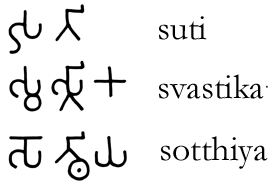
"The swasti of Sanskrit is the suti of Pali; the mystic cross, or swastika is only a monogrammatic symbol formed by the combination of the two syllables, su + ti = suti."
There are two problems with this.
  1. While there is a word suti in Pali it is equivalent to Sanskrit śruti 'hearing'. The Pali equivalent of svasti is sotthi; and svastika is either sotthiya or sotthika. Cunningham is simply mistaken about this.
  2. The two letters su + ti in Brāhmī script are not much like the svastika. This can easily been seen in the accompanying image on the right, where I have written the word in the Brāhmī script. I've included the Sanskrit and Pali words for comparison. Cunningham's imagination has run away with him.
Below are two examples of donation inscriptions from the south gate of the Sanchi stupa complex taken from Cunningham's book (plate XLX, p.449). Note that both begin with a lucky svastika.


The top line reads vīrasu bhikhuno dānaṃ - i.e. "the donation of Bhikkhu Vīrasu." The lower inscription also ends with dānaṃ, and the name in this case is perhaps pānajāla (I'm unsure about ). Professor Greg Schopen has noted that these inscriptions recording donations from bhikkhus and bhikkhunis seem to contradict the traditional narratives of monks and nuns not owning property or handling money. The last symbol on line 2 apparently represents the three jewels, and frequently accompanies such inscriptions.

The word svasti (स्वस्ति) is a feminine noun probably deriving from su- + asti: where su- is a prefix cognate with the European eu- meaning 'good, well, excellent' and asti is from the verb √as 'to be'. Perhaps through constant use the word asti, originally the 3rd person singular present of √as, came be an indeclinable particle meaning 'existent, being'. Sandhi rules mean that su+asti becomes svasti which means 'well-being', and is used in the sense of 'auspicious, good fortune, luck, success, and prosperity'. In other words svasti is rooted in ancient Indian superstition. Note that in all modern transliterations of Sanskrit व is written va. So how do we come to spell our word swastika with a 'w'? There could be for two reasons: firstly modern Hindi and other North India IE languages transliterate व as wa, and we could be taking the word not from Sanskrit, but from Hindi; secondly Cunningham (back in 1854) was transliterating Sanskrit व as wa as well and other Victorians might have followed suit. The suffix -ka is adjectival and so svastika (स्वस्तिक) should mean something like 'related to well-being'. However in this form we would normally expect the root vowel to change to its strongest (vṛddhi) grade svāstika, and this does not happen in this case.

Müller (in Schliemann, p.346-7) notes that svasti occurs throughout 'the Veda' [sic; presumably he means the Ṛgveda where it appears a few dozen times]. It occurs both as a noun meaning 'happiness', and an adverb meaning 'well' or 'hail'. Müller suggests it would correspond to Greek εὐστική (eustikē) from εὐστώ (eustō), however neither form occurs in my Greek Dictionaries. Though svasti occurs in the Ṛgveda, svastika does not. Müller traces the earliest occurrence of svastika to Pāṇini's grammar, the Aṣṭādhyāyī, in the context of ear markers for cows to show who their owner was. Pāṇini discusses a point of grammar when making a compound using svastika and karṇa, the word for ear. I've seen no earlier reference to the word svastika, though the symbol itself was in use in the Indus Valley civilisation.

Müller says that the svastika only refers to the right-facing cross , while the left-facing cross is called sauvastika, and incidentally does not believe that the symbol is a monogram (Schliemann p.347). [4] The form sauvastika doesn't make sense to me. If the root vowel underwent vṛddhi (a > ā) then the word would be svāstika; but there are a number of words in MW which have this change: sva > sauva. If it is su undergoing vṛddhi (prior to combining with asti) then the form ought to be sāvasti (su > sau and au + a > āva). If sauvasti is the vṛddhi form, then we'd expect the weakest grade to be suvasti, but it is not. Others also insist on this difference between the two forms, but my impression of looking at Buddhist art is that no differentiation is made by artists. The BBC h2g2 webpage on svastika suggests that the distinction between svastika and sauvastika only dates from the 19th century, though the claim is not referenced. Sauvastika occurs in Sanskrit dictionaries, but not in relation to the symbol - a sauvastika according to Boehtlingk is a Hauspriester eines Fürsten 'The house priest of a prince'. MW suggests 'benedictive, salutary; family Brahmin'.

I would end by saying that the svastika is an element of pan-Indian superstition - a lucky sign. As such we should probably not mourn too much that it was taken over by the Nazis and given an indelibly negative connotation in the West. As modern, Western Buddhists we don't need lucky symbols, and we don't rely on luck. We practice. The svastika is really of historical interest only and there is no pressing need to rehabilitate it. 

~~oOo~~

Notes
  1. Craig S. Smith, "In China's Religious Crackdown, An Ancient Symbol Gets the Boot," Wall Street Journal 8 September 1999, p. B1;
  2. The relevant page references in the online version of Goblet d'Alviella (1894) are incorrect. I have located printed copies in the Cambridge University Library, and supplied correct references in this article.
  3. This story is well recounted in Allen (2002) - see esp. p.214f. I recommend this book. I gather from a brief conversation I had with Charles, last year at a lecture by Prof. Gombrich, that his next book will be on King Aśoka which I'm eager to read.
  4. Goblet d'Alviella (1894, p. 46) appears to use Müller's remarks to contradict Cunningham, but in Schliemann (1880) Müller specifically refers to the Sanskrit spelling, not the supposed Pali of Cunningham. So the two statements are not really connected.

Bibliography
  • Allen, Charles. (2002) The Buddha and the Sahibs. London : John Murray.
  • Cunningham, Alexander. (1854) The Bhilsa topes, or, Buddhist monuments of central India : comprising a brief historical sketch of the rise, progress, and decline of Buddhism; with an account of the opening and examination of the various groups of topes around Bhilsa. London : Smith, Elder. [possibly the earliest recorded use of the word swastika in English].
  • Goblet d'Alviella, E. (1894) The Migration of Symbols. London: A. Constable and Co. Online: http://www.sacred-texts.com/sym/mosy/index.htm
  • Monier-Williams, Monier. (1899) A Sanskrit-English dictionary : etymologically and philologically arranged with special reference to cognate Indo-European languages. [New ed. greatly enlarged and improved with the collaboration of E. Leumann, C. Cappeller and other scholars.] Asian Education Services : New Delhi, 2008.
  • Schliemann, Henry. (1880). Ilios : the city and country of the Trojans : the results of researches and discoveries on the site of Troy and through the Troad in the years 1871-72-73-78-79. London : John Murray.

See Also

Gary A. David. The Four Arms of Destiny: Swastikas in the Hopi World & Beyond.

13 May 2011

Buddha Day

IN THE TRIRATNA MOVEMENT, like many other Buddhist groups, we celebrate the Buddha's awakening about now, to coincide with the 2nd full moon after the Vernal Equinox. We call this festival Buddha Day, and it is trined with Dharma Day, two full moons later in July, and Sangha Day in November (a non-traditional date I think). I note that my local centre is celebrating Wesak this year instead of Buddha Day, and that Wesak has been creeping into our vocabulary. To my consternation I note that our main website has Wesak as the name of this festival as well.

The word buddha is, of course, the past-participle of the verbal root √budh 'to understand, to wake up'. It's often said that Buddha is a title, but in fact it is a description. In calling Gautama 'the Buddha' we are saying that he is someone who has woken up or understood. On Buddha Day we celebrate the fact of his having woken up.

Wesak, usually pronounced with wes to rhyme with 'mess' by English speakers, is the Sinhalese (corrupt) pronunciation of the Pali name of the 2nd lunar month of the ancient Indian calendar. In Sanskrit it is vaiśākha, and in Pali vesākha. The full title should be in Sanskrit vaiśākha-pūrṇimā and in Pali vesākha-puṇṇamī. The name itself has little spiritual significance. Vaiśākha means 'connected with visākha' and visākha means 'branched or forked' from vi- (divided, originally from dvi 'two') and sākha (a branch). And pūrṇimā means 'full moon.' So it just means the full moon day of the second lunar month, in an archaic calender that called the Spring Equinox New Year.

Most South-East Asian countries follow the Sinhalese by calling the festival some phonetic variant of the Pali vesākha. Burma, apparently, uses their own name for the same lunar month: Kason. The rest of the Buddhist world which celebrates the festival usually opt for a local name. In Japan it is hanamatsuri (花祭), literally 'flower festival'. In Tibet they say sagé dawa (sa ga'i zla ba ས་གའི་ཟླ་བ) which is also just the name of the lunar month in which the festival occurs, though their calendar is a bit different. And so on.

So there's nothing special or particularly significant about the name Wesak. The direct equivalent would be calling our festival "May Full Moon"or just "May", and mispronouncing the words slightly.

In India two different Sanskrit terms are used. 1. buddha-pūrṇimā 'Buddha full moon' - where pūrṇimā, again, means 'full moon'; and 2. buddha-jayantī 'the Buddha's victory', where jayantī means 'victorious'. I'm not sure why the feminine is used, but it clearly comes from the present participle jayanta 'victorious' of the verb √ji 'to conquer'. These two at least have the advantage of stating explicitly that they celebrate Gautama having awakened, and jayantī is really quite descriptive. The festival celebrates the Buddha's victory over dukkha ( or death, or Māra, etc.), and it just happens to be on the full moon day of the second lunar month of the old Indian calendar because that's the traditional date.

Calling the festival Buddha Day, as opposed to one or other of the Asian Buddhist terms, was doubtless part of Sangharakshita's conscious break with traditional Buddhism in the late 1960s. In a recent communique to the Triratna Movement he said:
The Triratna Buddhist Order and Community is not a continuation of the Tibetan tradition, or of any other particular Buddhist tradition. The particular iconographic, theoretical, and ritual frameworks of Tibetan or other traditions are not our reference point. This should be plain from the imagery, ceremonies, and rhetoric in common use in the Triratna Buddhist Community.
When I asked him what he though about this creep towards using Wesak he replied:
"So far as I am concerned, it is Buddha Day, to correspond with Dharma Day and Sangha Day. I don’t know how the term Wesak has crept in. It was, however, in common use among English Buddhists, mainly Theravadins, many years ago. I think the Buddhist Society still uses the term."
It's been suggested to me, in a discussion about this issue on Facebook, that one of reasons for using Wesak is that everyone is doing it. And yet for four decades we have been critical of this kind of group-think, of doing things just to fit in. I don't find this reasoning very convincing. It's clear that we are celebrating the Buddha's enlightenment, and not any particular traditional observance.

I've given some thought to this matter and have wondered whether the drift into using a traditional title for the festival is symptomatic of the commodification and commoditization of Buddhism. Commodification is the process of assigning monetary value to something that has previously been priceless: a move from social value to market value. This is one of the most potent forces in Western society at present - so that we truly are in a position these days to know 'the price of everything and the value of nothing' (Oscar Wilde. Lord Darlington, Act III). Commoditization on the other hand is when a different brands of a product become indistinguishable to the consumer. This tends to cancel out decisions based on features and causes consumers to decide on price - often leading to price wars.

If you go to a good book store they will have several dozen books on Buddhism, not to mention CDs and DVDs. Old classics go out of print and an endless stream of new books come out each year. Few of them add much to the gene pool. Most recycle what are becoming clichés. At the same time Buddhism is repackaged as lifestyle advice and sold under various guises. Although some centres operate on a donation basis, most of us have mortgages to pay, so our classes cost money. Of itself this is not necessarily a bad thing. But there is little in the popular imagination to distinguish what we do, from what the local Yoga centre, or the local Mindfulness centre do. The market for meditation and wisdom teachings is becoming commodified. This is fuelled by monism - the belief that all spiritual traditions aim at one truth, that beneath the surface "all is one", and all religions are essentially the same. I don't think price, more than distinctive teachings, drives choices about which tradition we get involved with, but I do think things like physical proximity and convenient opening hours do.

On one hand perhaps some of us buy into the 'all is one' meme, and just want to get along with everyone? Perhaps we don't feel so confident these days and seek safety in numbers? Perhaps we ourselves have lost a sense of our distinctiveness, or perhaps we are afraid that in asserting our distinctiveness we risk rejection by traditional Buddhists (with more accusations of arrogance)? Perhaps we just are not really individuals in the full sense, and are too easily swayed by the popular.

On the other hand the best response to a commoditized market place is to increase the value of the product - so most of our centres offer a range of services. In addition to more or less secular meditation courses, as well as basic classes on Buddhism, and more in-depth and explicitly Buddhist instruction, we teach Hatha Yoga, Tai Chi, Mindfulness Based Stress Reduction. You also get access to a community of like minded individuals. And of course part of community life is collective practice and celebrations.

So the response and the situation are both complex. And I don't mean to suggest or imply that Triratna Buddhists knowingly or willingly pursue commodification and commoditization - I think the opposite is true, we generally resist it. It's happening around us though, and because it is the mindset of the wider society, we can't help but be influenced to some extent. Most of the people we interact with tacitly support this kind of change because it means that they are materially better off, at least in the short term. We probably unconsciously participate simply by being members of a particular kind of society and culture. I think it's important that we be aware of this trend and resist it. But we also need to resist the blending in and settling down tendency. Our movement began as an explicit break with tradition. We need to be wary of treating tradition as a fall back. Falling back on tradition would be a disaster for us.

And I think adopting the name Wesak is a bit like this. It's not the result of a conscious consensus to change. There's been no discussion about it. We're expressing a sense of lack, or even, from what some people say, a sense of discomfort or even dislike. I'm playing this up a bit to make a point. But also I happen to be in contact with a number of people, almost none of whom are part of our movement, who are very excited about breaking with tradition. They call themselves 'secular Buddhists', or even 'non-Buddhists', and they write wonderful searing polemics of tradition. Forty years ago what Sangharakshita did was radical and caused a stir in the establishment; and yes, even some hatred. His polemics made him very unpopular in some circles (e.g. Forty-Three Years Ago, and Was the Buddha a Bhikkhu?) Right now that same attitude is becoming hot. Once we were the world leaders in this, now we appear to be choosing to fit in. I was attracted to the Triratna Community for many reasons, not least of which was that it was and is a community. But I also liked the zeitgeist, the zeal and zest, as well as the idealism and ideals. I wanted to believe. 18 years on I'm older and more cynical, and perhaps a little wiser.

I hope I'm not merely being cynical in criticising the use of Wesak. It's not a name that speaks to me the way that Buddha Day does. Some of my friends feel differently and it occurred to me that public holidays here in the UK are rather prosaically named. In New Zealand we have Waitangi Day, ANZAC Day, The Queen's Birthday, Labour Day which are full of meaning and history for us. "The May Bank Holiday" doesn't ring any bells for me, while Buddha Day is familiar territory. For Brits it's the other way around.

If I thought anyone would take any notice, I would suggest we have it on the same date each year, the way that Shingon Buddhists celebrate Kūkai's birth on the 15th of June (15th day of the 6th month in the Japanese lunar calendar); or, say, on the second Sunday of May each year. Make a clean break of it. However we seem to be sentimental about the archaic Indian lunar calendar, even when we have almost no comprehension of it. I have to confess that every fact I cite about it here is recently looked up for the purposes of writing this.

The second full moon after the Vernal Equinox of 2011 is on Tuesday 17th May, and that is when I will be celebrating Buddha Day - the Triratna Movement festival celebrating the the Awakening of the Awakened One.

~~oOo~~

06 May 2011

The Abyss of Death

In this post I want to look at a theme that I explored in my recent talk at the London Buddhist Centre (available on Free Buddhist Audio). Thomas Metzinger points out that evolution has imbued all life with a powerful urge to continuity. We humans experience this on a number of levels - we will do almost anything to ensure our personal continuity; and most of us will also try to ensure our genetic continuity by procreating. We share this fundamental drive with all life - animals, plants, and even viruses. Indeed a virus does little else except reproduce itself with no sense of purpose, but relentless efficiency. The 'urge' for continuity underlies all of our other basic needs - shelter, food, water, air. I did not see the film 127 Hours, but I know the story - a man is trapped by a boulder while climbing and after several days cuts his own arm off in order to get free. It's a true story. Likewise people survive through all kinds of adversity and oppression - concentration camps, ship wrecks, wars, and slavery. The survival instinct is extremely powerful.

But at the same time evolution has given us consciousness. Emerging (probably) out of our need to regulate our internal milieu and optimise our response to the environment we animals began to model our own internal states using our complex brains. At some point our awareness of ourselves became part of the picture - we became aware of ourselves as being aware. The advantages of this are manifold. We can better grasp social interactions because we can understand what another is feeling through emulating emotions; we can learn what others do by imitating them; and we can imagine various possibilities of action and weigh the consequences. The benefits of having an ego are huge, and in particular it allows us to be moral beings. If any other animals have this ability it is only very rudimentary.

But Metzinger also notes that with the evolution of this amazing new ability comes another kind of knowledge. The knowledge that we will grow old, become ill, and die. Death is a certainty. When we see a corpse we know that something we value is missing. We can hold decay at bay with preservatives such as formaldehyde or honey, but the corpse is only preserved and does not continue except as inert matter. Life leaves us, consciousness leaves us. Seeing a corpse can be a profoundly, existentially disturbing experience, but it is also entirely natural and inevitable for all living things to die.

This certain knowledge of the inevitability of death creates a conflict with our most basic and powerful drive which is for continuity. It is the proverbial irresistible force meeting an immovable object. Not continuing is an option few of us can really take seriously as an option because deep down inside our most singular and powerful drive is to keep going. We Buddhists have memorialised this conflict in the story of the four sights - in various different tellings the youthful Siddhartha sees old age, sickness and death, (as if) for the first time, and he is engulfed by the dilemma. In those days men and women left their home life and social ties to seek an answer - they were called śramaṇas 'toilers'. The Buddha to be joined first one and then another band of wanderers seeking the way to the deathless. Our story says that he eventually abandoned all previous methods and found the way on his own, and that this 'way' is what we pass on from one generation to the next. The details are specific to Buddhism, but the theme is universal.

Most human cultures have stories about post-mortem continuity, be it a return to earth (usually via some intermediate state) or arrival in some version of a perfect world. Although genuine nihilism does crop up from time to time, I think we are mostly naive eternalists. Almost all of these stories require consciousness to be distinct from matter, to be able to exist without a body - that is to say a mind/body duality. In Buddhism we even find it said that consciousness causes a body to come into being. Those who curate these stories -- priests -- often become powerful and rich, but at the very least they are usually respected and influential. However, even in the presence of powerful priests, ordinary folk will often maintain their own local traditions of continuity through local spirits and ghosts and the like. The interesting spin in India is that repeated rebirth came to be seen as a burden to be put down in favour of something more satisfying which the spiritual masters called variously brahman, vimokṣa or nirvaṇa.

Whatever we make of these stories - whether we take them literally or dismiss them, or find some compromise - we all face this tension between the continuity imperative and the certainty of our own death. The great magnitude of the tension is reflected in the grip we take on these stories - some people will kill or be killed before giving up their particular story. Many people are just not equipped to deal with the idea of death as a discontinuity, and most are not willing to see it that way. There often a hint of moral condemnation from religious people against those who declare that no continuity is possible. During his US Presidency George Bush apparently opined that an atheist could not be a citizen or a patriot for instance.

The fact of death is an abyss, a hole that can't be filled. It is not something we can fix on it's own level. But we can bring light to the situation. We can care, i.e. care about and care for other living beings. We can be kind and generous. We can be selfless. Although consciousness brings the abyss of knowledge of personal death, it brings the blessing of selfless acts of kindness. Ironically we find fulfilment in selflessness.

29 April 2011

First Person Perspective


McCory Photography
I've already blogged about Thomas Metzinger a couple of times. In this post I want to write about another of his ideas. His book The Ego Tunnel: The Science of the Mind and the Myth of the Self opens with the words "In this book, I will try to convince you that there is no such thing as a self" and as Buddhists we may immediately feel that this is familiar ground. However Metzinger is not a Buddhist, and sums up the Buddha as a pessimist who posited, "essentially, that life is not worth living". (Ego Tunnel, p.199) Of course I disagree with this summation - the Buddha wasn't a pessimist, and did not say this, although he did place limits on what kind of life is worth living.


In this post I want to look not at Metzinger's book, but at a talk he gave in 2005 as part of the Foerster Lectures on the Immortality of the Soul, (available on YouTube) entitled "Being No One" (also the title of a book) which explores the idea of a first person perspective.

Metzinger says that for there to be a first person perspective we need three 'target properties'
  1. mineness - a sense of ownership, particularly over the body.
  2. selfhood - the sense that "I am someone", and continuity through time.
  3. centredness - the sense that "I am the centre of my own subjective self".
I'm not sure where he got these criteria, but after working on the Alagaddūpama Sutta recently I am struck by a parallel. Selfhood in the Pāli texts is often summarised in the phrase:
etaṃ mama, eso'haṃasmi, eso me attā.
this is mine, I am this, this is my self.
I suggest that:
etaṃ mama = this is mine = mineness.
eso'hamasmi = I am this = centredness.
eso me attā = this is my self = selfhood.
The order is different but the criteria are almost identical. I've recently argued that these are general observations, and not specifically connected with Brahmanical ideas about ātman with which the only minimally overlap.[1] Buddhists will hopefully be familiar with the traditional analytical approach to deconstructing these statements, so I can focus on Metzinger's approach.

Drawing on work by Antonio Damasio and Ronald Melzack, Metzinger proposes we replace the notion of a 'self' with a theoretical entity which he calls a Phenomenal Self Model. This is a representational system, created in the brain, the content of which is us, ourselves. "We" are in fact a simulation. We simulate and emulate ourselves for ourselves, and thereby create what we call consciousness. This model is rooted in our proprioceptive sense (the information derived from muscle tension, inner-ear and other bodily sensations) according to Melzack; and in our bodily systems (especially endocrine, blood and viscera) and emotions according to Damasio. These (probably both) generate a constant input which is modelled in the brain for the purposes of regulation and optimisation. This model is sub-personal, it is not a 'person' in our heads directing our actions (there is no homunculus as it used to be called). What we call our 'self' is in fact simply a representation of our bodily, and mental states, combined with a representation of representing (reflexive awareness).

However this model is transparent to us - we do not understand ourselves to be relating to a model of reality, we understand ourselves to be relating to reality. This is because the processes which generate the model are not available to introspection - they happen too fast, and too seamlessly for us to see them. There was a clear evolutionary advantage to having this ability to model reality and use that model to guide our actions; but there is no advantage in knowing that we are doing this - we see a danger and react, but to complicate things by seeing the picture of a danger in our head as a picture would only slow our reactions down, and we would not survive. For Metzinger the transparency of the Phenomenal Self Model is a strong limit that we cannot break through. It only becomes obvious through detailed analysis of what goes wrong with consciousness in specific brain injuries. We are all naive realists according to Metzinger, i.e we think we interact directly with reality, because that is how it feels. It is probably this naive realism that makes us resistant to reductive explanations of consciousness - whether Buddhist or scientific. The mechanisms of consciousness are not available to introspection, but we feel (want, assume) it to be something more than simple biological processes, and we are baffled by complexity generally so we think of consciousness as something rather magical. We may be wrong.

Metzinger's critique of the idea of a first-person perspective centres on the way that the Phenomenal Self Model can go wrong. In the case of "mineness" for example, we get cases where our thoughts do not seem to under our control, as in schizophrenia. In unilateral hemi-neglect a person may not recognise their limbs as their own. In alien hand syndrome one of the hands appears to act independently of our conscious will. Likewise some delusional people experience everything that happens as caused by their intention - Metzinger relates meeting a person who stood all day looking out the window making the sun move. In the rubber-hand experiment we find that an artificial hand can become included in our body image by confusing the physical and visual senses. Finally he cites the case of a woman born with no arms or legs who never-the-less has phantom limb sensations. Having never had limbs where could such phantoms come from if not the brain itself? The sense of mineness is actually prone to error in many ways which would not be possible if it actually reflected our bodies. The sense of ownership is generated within the Phenomenal Self Model, within the brain.

Similarly the sense of selfhood is prone to malfunction. Various disorders of the dissociative type show that what R. D. Laing called 'ontological security' is by no means assured, and some people experience a complete breakdown of their sense of being a self, while remaining conscious. Or we may, through delusion, wrongly identify ourselves as some other person.

The first person perspective also capable of being disrupted: in out of body experiences for instance (which Metzinger has vivid experience of); and in mystical experiences of oneness with the universe. Compare Jill Bolte Taylor's description of her stroke in which the left-hemisphere of her brain shut down. (TED) Taylor's description of the breakdown of the first person perspective is similar to the mystical experience sometimes called oceanic boundary loss that is described by mystics of many traditions. Note that Taylor lost all language, the ability to speak, memory of who she was, and the ability to walk, but she did not lose consciousness nor the ability to make intentions or memories. However Taylor associates "I am" with the left hemisphere of the brain which "shut down" during here stroke - she remained conscious and aware, but with no sense of "I am".

So Metzinger argues that all of this plasticity and bugginess [my choice of terms] in the three qualities tells us that they do not exist as such, but are elements of a simulation. Consciousness, self-consciousness is a virtual reality. He sums up the idea with an annotated statement about the process of cognition.
I myself [the content of the currently active transparent self model] am seeing this object [the content of the transparent object-representation] and I am seeing it right now [as an element within a virtual window of presence (i.e. working memory)] with my own eyes [the simple story about "direct" sensory perception, which suffices for the evolutionary purposes of the brain].
He says "of course you don't see with your eyes!" We see with our visual perception systems. But we cannot experience these systems working, we just experience seeing. In the final part of the lecture two questions emerge from the the title of the lecture series which concerns the question of "the immortality of the soul". The first is: is the self an illusion? "For the self to be an illusion," says Metzinger, "there would have to be someone whose illusion it was, and there is no one," thus: "if it is an illusion, it is no one's illusion". The second question relates to immortality, and to this idea he says: "strictly speaking nobody is ever born, and nobody ever dies". His phrasing perhaps suggests a Vedanta outlook (we know he meditates but not in what tradition).

Having begun with the familiar and traversed some unfamiliar territory, we find ourselves back on familiar ground with these last statements. It sounds a lot like Buddhism - from a non-Buddhist scientific philosopher. But note that Metzinger is saying that the process is transparent, that it is not available to introspection - he does not seem to allow for a radical change in consciousness like bodhi. In traditional Buddhist terms there is no possibility of direct contact with reality - this becomes a contradiction in terms because consciousness is only a simulation. In my own terms, which derive mainly from the writing of Sue Hamilton, he does not allow for access to the khandhas, the apparatus of experience: he allows for no insight into the creation of a first person perspective which might allow for liberation from it in a positive sense. I believe, to some extent I know, that in meditation the Self Model becomes opaque and available to introspection.

In The Ego Tunnel Metzinger explores some of the ethical and even spiritual implications of his theory, and here he says some very interesting and attractive things which I will try to write about at some point. For more on Metzinger's theory see the self-model page on Scholarpedia.


Notes
  1. In making this claim I am consciously and explicitly contradicting both K. R. Norman and Richard Gombrich who see this particular phrase as a specific echo of the early Upaniṣads - Chāndogya in the case of Norman, and Bṛhadāranyaka for Gombrich. Part of my rebuttal is précised in the post Early Buddhists-and ātman/brahman - while the whole argument is set out in a longer but not quite finished essay. Suffice it to say, I do see a connection of a sort, but nothing to indicate that the Buddha had any direct contact with Upaniṣadic sages or was directly dealing with issues central to their texts. The papers I am thinking of are:
    • Gombrich, Richard. (1990) 'Recovering the Buddha’s Message.' The Buddhist Forum: Seminar Papers 1987-88. Ed. T. Skorupski, London, SOAS.
    • Norman, K. R. (1981) 'A note on attā in the Alagaddūpama-sutta.' Studies in Indian Philosophy (Memorial volume for Pandit Sukhlaji Sanghvi), Ahmedabad, pp. [Reprinted in Collected Papers, Oxford: Pali Text Society, 1991; vol. ii, p.200-209.]


22 April 2011

Parallels to the Kālāma Sutta

THE KĀLĀMA SUTTA is probably over-rated. It is an interesting sutta, but far too much has been claimed for it, and so it has become something of an albatross around the neck of Buddhists. It's wrongly quoted in support of a raft of ideas, many rooted in 19th Century Romanticism, that appeal to modern Buddhists but that don't have much to do with traditional Buddhism.

Still, it was a good exercise to translate it, and see for myself what it actually says. I concluded that far from being a "charter for free enquiry" as Soma Thera has suggested, it is a more of an apologetic for Buddhist morality. The text basically says this: "if you are an intelligent person, then you will be a good Buddhist". It is aimed at people who are already Buddhist, so it is really saying, "congratulations on choosing Buddhism as your religion, the choice of all right-thinking people". The morality it portrays is attractive, however, because it it is located in relationship with other people. We Buddhists can often talk about 'skilful' and 'unskilful' actions in the abstract, but in the Kālāma Sutta it's clear that these terms convey qualities of how we relate to people.

In any case, the Kālāma Sutta is puzzling in some respects. Although teachers who "proclaim one thing and dispute everything else" are cited, we never quite find out what they teach, nor why they disagree. And, although the sutta portrays the ideal Buddhist as dwelling in the brahmavihāras, we are not told how this relates to the morality preceding it. Nor is it clear how the four consolations at the end of the sutta relate to the rest of it.

So it was with interest that I stumbled on the Pāṭaliya Sutta (SN 42.13; PTS S iv.340). Although the setting is different, this is basically the same story as the Kālāma Sutta. [1] Here the Buddha is in Koliya, rather than Kosala, and the town is called Uttara, instead of Kesaputta. The teaching is delivered to a single person, rather than to a group. However, the outline of part iii of this sutta is the same as the Kālāma Sutta, and many of the same standard phrases occur in the same places. In the Pāṭaliya various teachers come and teach different things, though this time the teachings are spelled out as various extreme views on the connection between actions and consequences. One can see why their views conflict because they take diametrically opposed stances. However, the result is the same: doubt and perplexity. The solution here, though, is to achieve concentration of dhamma and concentration of mind.

One begins by practising the ten right actions. [2] One who abandons the unskilful states of mind dwells in the brahmavihāra states - mettā, karuṇā, muditā, upekkhā. So here the connection between morality and the brahmavihāras is explicit. Contra later traditions, here one cultivates loving kindness, compassion, etc., primarily through practising the precepts; that is, primarily through cultivating non-harming (and its corollaries) towards other people. Rather than a seated meditation practice, here the brahmavihāras seem to emerge from personal interactions. From this sublime state of constantly relating to all beings on the basis of kindness and compassion, elsewhere compared to liberation itself, one is able to reflect properly on the content of the various teachings on actions and consequences.

But here's the thing: the text does not untangle the views of these other teachers. It just says that whatever the truth is, the Buddhist is better off (like the Kālāma Sutta this text is a Buddhist apologetic). Whatever the various doctrines are, the virtuous person, dwelling in brahmavihāras, knows that they themselves never oppress anyone and, therefore, in each case, they are "lucky both ways": in this life, and in any future life, they are protected by their harmless lifestyle. There is no attempt to engage with the metaphysics of the various doctrines and ideologies. This lack of interest in metaphysics seems to underlie the argument that it doesn't matter what you believe - "Buddhism without beliefs", as it is sometimes called. And, maybe, it doesn't so long as you relate to all beings with loving kindness and compassion and sympathy. In reality, the view that it doesn't matter what you believe is a philosophical fudge. The text is very much in the camp of saying that actions do have consequences, and that we can think of those consequences, at the very least as desirable and undesirable, but probably in terms of good and evil, as well. And this is a very definite metaphysical position on actions having consequences. Only an naive reading of the Kālāna Sutta concludes that it doesn't matter what you believe, but here in the Pāṭaliya Sutta it is much more clear.

Knowing that they are protected by their own virtue, the ideal Buddhist experiences joy, rapture, serenity, bliss and concentration (pamojja, pīti, passadhi, sukha, samādhi) . These are the central steps on the Spiral Path (or upanisās, as I call them) and the steps that unite all the textual variations of the Spiral Path. I also see them relating to the jhānas. With joy as a base, I think each item from rapture to samādhi represents the primary quality of a series of increasingly refined states of consciousness roughly equivalent to the first four jhānas.

It is from integration (samādhi) that one is able to dispel perplexity. From a state of equanimous absorption one is able to see things as they are. Though this text leaves the reader at samādhi, dozens of other texts make it clear that it is on the basis of samādhi that knowledge and vision of things as they are (yathābhūta-ñāṇadassana) arises.

The Pāṭaliya Sutta has some advantages over the Kālāma Sutta. Firstly, the details of the story are more complete. The kinds of teachings which perplex are spelled out, and it is clear why anyone espousing those views would vehemently disagree with other views. The argument is over whether actions have consequences. Some argue that there are no consequences. One graphic image used for this is going along the banks of the Ganges killing or mutilating every living being. One teacher argues that no evil will result, another that it most certainly will result in evil. Note here that we are not arguing over whether the act itself is evil - we are concerned with consequences. This is a feature of Indian moral philosophy as portrayed in Buddhist texts (whether this is a genuine portrait of Indian moral philosophy is a moot point).

The method of the Buddha is also spelled out, and more clearly linked to the threefold path of morality, meditation and wisdom. Because it incorporates the Spiral Path, this is a more coherent telling of the story. The Spiral Path has the special function of showing how liberation is possible. Without it, it is more difficult to see how the unawakened can create the conditions for awakening through living an ethical life, through paying attention in particular ways, and through contemplations leading to seeing through (vipassana). [3]

This sutta also allows us to see how the four consolations of the ideal Buddhist (ariya-savaka) relate to the views being expressed by the various teachers, and to "being lucky both ways". They aren't stand alone ideas, but link back to the morality under discussion.

This story is told in full no less than three times in the Canon, each time in a different place to a different audience (see note 1). So we should careful about associating it too strongly with the Kālāmas. It's a story, remembered in several different forms. In addition, there are cross-over points with some other stories. I think these examples of multiple recensions of stories, with substantial differences, represent different oral lineages. Though I don't have the patience or the skill to do so, I predict that through a detailed examination of the language used in these parallel versions of stories it would be possible to identify lineages of story telling. I gather, for instance, that there are stylistic and even linguistic differences between the various nikāyas - though these might be due to the collators imposing a 'house style' on their collection.

All this goes to show that while making an accurate translation is invaluable, sometimes reading a sutta in context is as important if we are going to understand it fully. And filling out the context can mean painstaking work identifying parallels and related texts. Sometimes the differences between recensions of a story can tell us more than the similarities.

~~oOo~~

Notes
  1. The Kālāma Sutta (AN 3.65) is repeated more or less verbatim in the next sutta AN 3.66 (A i.190) where it is spoken by the Elder Nandaka to Sāḷha and Rohaṇa; AN 4.193 (A ii.190) contains all of the parts dealing with morality and crossovers with SN 42.13 (S iv.340) which itself spells out the doctrines being disputed (and shows that the consolations are related to them) and that the brahmavihāras are related to the practice of morality; MN 56 (M i.375) shares the SN 42.13 framing story of magical powers for converting other religieux. We should also read the sutta in the light of MN 136 which shows that predicting karmic outcomes is difficult, and MN 60 about alternatives to believing in karma and rebirth.
  2. i.e., abstention from killing, taking the not given, sexual misconduct, lying, harsh, divisive and idle speech, covetousness, aversion and wrong views - aka the Ten Precepts which are followed by members of the Triratna Order, and by Shingon Buddhists. Sangharakshita has written that: " abstention from killing living beings, or love... is the most direct and most important manifestation of the spiritual and existential act of Going for Refuge. Moreover, it is a principle that finds expression, in one way or another, and to a greater or lesser degree, not only in the First Precept itself, but in all the other Precepts as well." (The Ten Pillars, p.53)
  3. More than once I have been tempted to suggest that we stop using 'insight' as a translation, as the word has other uses in general conversation. Vipassana is from vi- with several senses, but here probably meaning 'through'; and passana 'seen' (a past participle from √paś 'to see'. So in-sight 'to see into' is not accurate in any case! Through-sight would be more accurate. We could replace it with the Greek derived term diaphany, on the model of epiphany. The -phany part comes from the verb phainein "to show"; while dia- means 'across or though' and is very likely cognate with Sanskrit vi- which also ultimately derives from the PIE word for 'two'. So diaphany means 'showing through, or seeing through'. It would be related to diaphanous 'transparent'. The advantage being that we could use insight for it's intended purpose of talking about self knowledge.
Related Posts with Thumbnails